Escape Velocity: Four Professionals on Breaking Free From What’s Holding You Back
It happens to almost every ambitious professional. At some point in your career, whether you’re two years in or 10, you realize you’re stuck. From the outside, everything seems fine. You’re doing good work. But it no longer feels like you’re moving forward.
Sometimes that feeling points to a real gap, like a skill you haven’t developed or an opportunity you haven’t found. Other times, that’s not the problem at all. Maybe a mindset or habit is holding you back, and it dawns on you only when a project, a client, or a conversation brings it out.
Breaking free from that pull was the subject of this year’s Equity Methods offsite panel. Every year, we step away from the day-to-day to reflect on where we’re headed, both individually and as a firm. With outer space as the theme for this year’s offsite, the panel seized on the concept of escape velocity, or the speed an object needs to break free from gravitational pull. For panelists, gravitational pull was whatever comfort, habit, or identity was keeping them in place. Here’s what each of them did when the pull became visible.
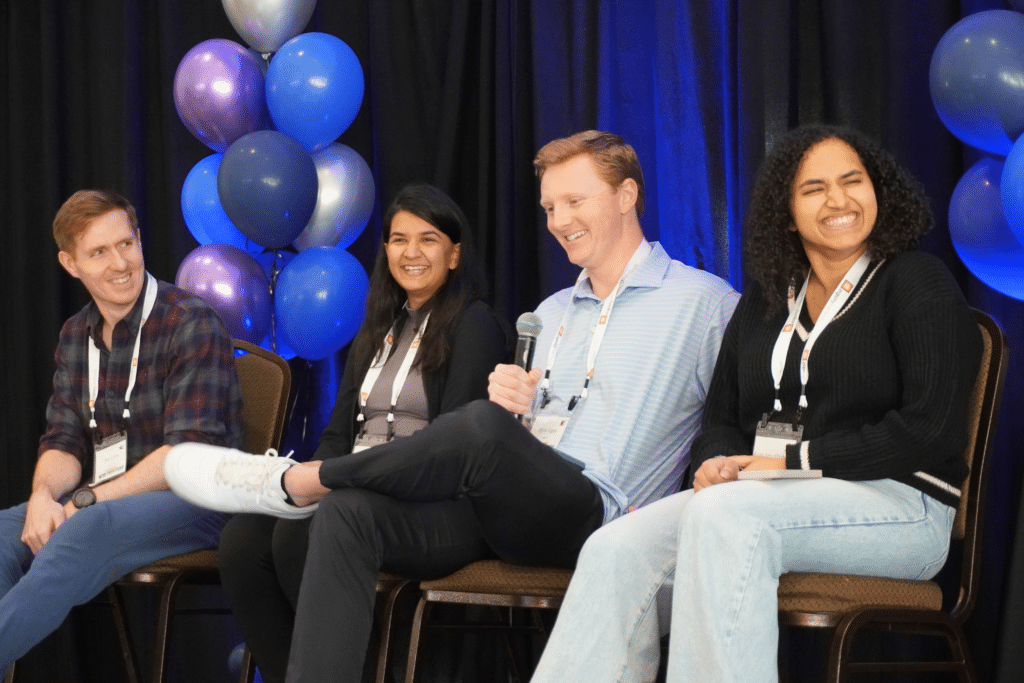
Ben: The Relationships He Built
When Ben was asked to move from direct client work into infrastructure development and architecture, a role that would let him help more people, he understood the reasoning. He still resisted.
What finally broke the cycle was a series of conversations with his peers, who kept playing devil’s advocate.
“Does the client really need you, or do they just need the work done well?”
Each time Ben had an answer, they came back with another question. Eventually he ran out of excuses. He realized he was holding onto something he’d built instead of doing what was best for his clients.
Looking back, Ben credits those conversations with helping him see what he couldn’t see on his own. His peers, the people on the outside looking in, gave him additional perspectives and data. It’s reinforced his belief that in work and in life, we need people around us who are supportive but also challenge us to become better versions of ourselves.
Today, Ben is focused on artificial intelligence. It’s a field developing so quickly that almost everyone is learning in public. That’s a new experience for someone who spent years being the person with the answers. Along with the rest of the development team, he’s responsibly building AI tools that give Equity Methods employees more time and mental capacity to innovate, streamline processes, and do what they do best. For Ben, supporting the entire firm has been exciting and well worth leaving his comfort zone.
His advice for early to mid-career professionals:
“The problem is never trying something and failing; the problem is learning nothing and assuming that someone else will figure it out.”
Ryan: The Way He Worked
Ryan’s gravitational pull was subtler. It was a way of working that had always served him well, until it didn’t.
When he joined a large client engagement with more moving parts than even he was used to, he realized his usual approach wasn’t enough. He already had strong project management skills, but this was a whole new level of complexity. He took it as a signal to rethink how he worked.
“There are usually more resources and creative solutions available to you than you think. You just need to take a moment to ask others for guidance.”
What helped Ryan was feedback. People usually see it as an anxiety-inducing conversation where someone critiques your work. But Ryan came to see it differently, as a way to get outside his own thinking at the exact moment his usual approach had stopped working.
As Ryan put it during the panel, “A huge benefit of working here is the freedom you have to influence positive outcomes.” Instead of simply powering through a complicated engagement, he stepped back, thought strategically, and invested some creativity upfront. That kind of planning can pay dividends in the long run.
Ryan wants to keep improving how he manages projects over the next year. He’d like to get to the point where he can split projects into smaller pieces and figure out how to succeed on each of them. That means experimenting with different techniques, keeping what works, and applying his own spin to make them second nature.
Ryan’s advice is evergreen no matter what stage of your career you’re in:
“Seek out help from others, and don’t shy away from opportunities to learn.”
Disha: The Comfort of Just Getting It Done
For Disha, the first gravitational pull was the comfort of simply delivering what the client asked for. That changed during a proxy project that started as a standard implementation and ended with the client asking, “What more can you do for us?” That question landed differently than she expected. It told her the relationship had moved beyond a single workstream. The most valuable thing she and her team could offer was showing up as a trusted advisor, guiding their clients through complexity and helping them get ahead of issues before they take root.
Stepping into that advisor role, though, introduced a new pull. Engagements rarely unfold exactly as planned. Data can be messy, client priorities can change, and team members may come and go. When everything around Disha is moving, the easiest answer is to do the work herself. She’s worked to resist that instinct ever since, learning to stay accountable without becoming a bottleneck, and trusting the process and her teammates to carry their share.
“Because if I’m doing everything, what value am I adding to the team? How am I helping others grow? And honestly, if I never delegate, how do I ever learn something new myself?”
Disha has also learned that problem-solving is rarely linear. As she explained during the panel: “For me, it was a mix of asking the team for similar scenarios, leveraging the technical research skills from my prior job, and learning how to creatively package a solution while explaining the solution in plain English. Breaking down the problem and knowing which skill to draw on at the right moment, that’s what got us through.”
When the pressure builds, especially during year-end and the first quarter, Disha relies on a simple routine. She goes home and talks through her day with her husband, which helps put everything into perspective.
She closed with advice for anyone facing a similar climb:
“The hike is never easy, but the view at the top makes every steep mile worth it.”
Kripa: The Model She Was Sure Was Right
“If we define wins as things that go exactly as planned, we’re going to avoid the very projects that help us grow the most.”
Kripa’s gravitational pull was the belief that technical correctness was enough. She was part of a team that built a model for a private equity-backed firm. The private equity sponsor approved it, so she assumed the project had been a success. That’s why she was surprised when the client found the model’s output too complicated to use.
The experience changed how she thought about client service. A model can be technically correct and still fall short if it doesn’t meet the client’s needs. From then on, she approached projects with more flexibility, using client feedback to make her work more useful.
Today, Kripa is focused on communicating technical work in a way clients can understand, trust, and act on. That’s still uncomfortable for her, but it forces her to slow down and think beyond implementation. She now asks herself, “How would I explain this to the client? How can I make this more useful?” Because communication is so important to what Equity Methods does, she sees every client interaction as another opportunity to improve.
Like the other panelists, Kripa credits much of her growth to the people around her. She regularly explores ideas with teammates, challenges assumptions, and builds on others’ perspectives. Whenever she hits a roadblock, she circles the office until she finds someone to talk through the problem with (a “victim,” she joked). Those conversations don’t eliminate uncertainty. But they do make it easier to work through it and keep moving forward.
That’s a Wrap
Ben, Ryan, Disha, and Kripa each felt the pull of something familiar. They each found a way to move through it, but none of them did it alone. They each had someone who helped them see it differently.
Now it’s your turn. What’s the gravitational pull that’s keeping you in place, and what’s your escape velocity?