Subscribe to Our Newsletter
Hear more from Equity Methods: Your trusted partner in equity compensation excellence.

Thousands of conversations with hundreds of companies each year give our team a wide-angle view of what’s on practitioners’ minds. In this mailbag, we highlight a few recent topics we find particularly interesting—beyond the basics, but still relevant to a broad range of companies.
Once again, we’ve curated real questions from clients and colleagues, anonymizing and refining them for clarity. Our goal is to share the practical advice and thinking they inspire.
* * * * * * * *
This is a great question about efficiency in plan design. It may seem counterintuitive, but under the right circumstances, features that appear unfriendly to recipients can absolutely deliver more compensation at the same cost.
Here’s how it works. Market awards (those based on TSR, price hurdles, and the like) have a fixed accounting cost based on their grant-date fair value as determined using a Monte Carlo simulation. That cost doesn’t change, regardless of how the award ultimately pays out.
A lower maximum payout results in a lower grant-date fair value. If a company uses that fair value to set the number of shares it grants, the same target compensation value can therefore buy more shares.
Consider a target grant of $10,000 with a $10 share price. Design 1 is a standard relative TSR performance award with a maximum payout of 200%, resulting in a grant-date fair value of $13.50 per share. Design 2 is identical, but with a reduced maximum payout of 150%, earning it a lower fair value of $11.50.

As shown above, Design 1 delivers 741 shares, while Design 2 delivers 870. That’s 129 additional shares, or 17% more, under Design 2.
For Design 2 to be more favorable to recipients, the additional 129 shares simply need to be worth more than the extra upside that Design 1 provides. We can see how that plays out by comparing the designs across low, moderate, and high payout scenarios.
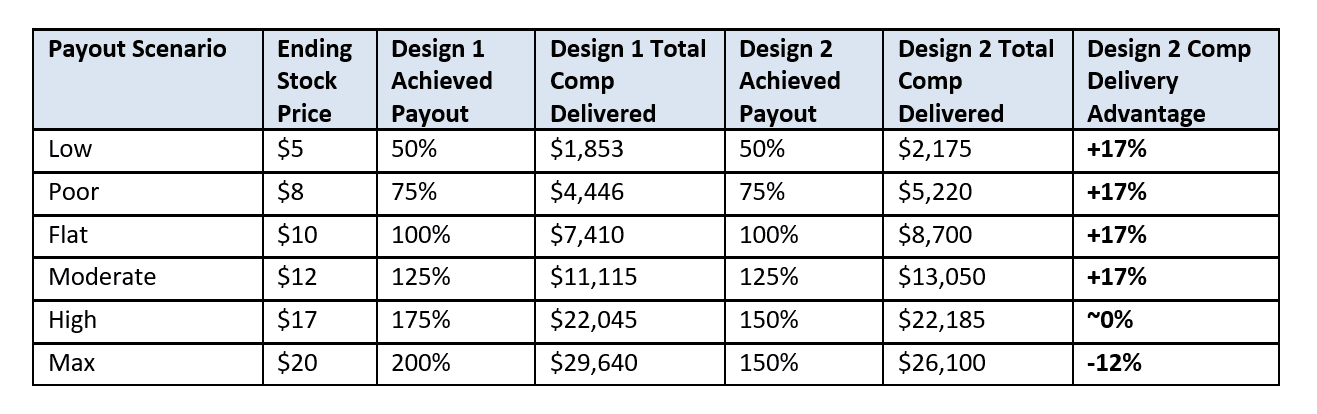
As you might suspect, Design 2 delivers noticeably more compensation whenever the payout percentage is the same for both awards—in this case, at any payout up to 150%. Design 1 becomes more favorable only at highest payout levels, with the breakeven point falling roughly halfway between the two maximum payouts. As a result, the lower maximum in Design 2 delivers more compensation across most potential outcomes.
Of course, neither design is strictly better for recipients in all circumstances, and changes in granting practices (such as not reinvesting cost savings into larger grants) can flip the logic entirely. When evaluating whether a given design change makes sense, communication with recipients and other stakeholders is critical, and decisions should be informed by thorough modeling to understand how the design will behave in different scenarios. We’re happy to support this modeling and decision-making if your team is considering a similar change.
Rule 10b5-1 trading plans are common for employees who possess material nonpublic information (MNPI), but other employees with access to MNPI can establish a plan too. They may do so voluntarily to facilitate regular, automated sales, or because company policy requires employees in certain key roles to adopt 10b5-1 plans.
If a non-MNPI individual elects to enter into a 10b5-1 plan, they generally must comply with the applicable conditions of the rule to qualify for its affirmative defense against insider trading liability. These include:
Section 16 officers and directors face more stringent cooling-off requirements following the adoption or modification of a Rule 10b5-1 plan. Trading cannot begin until the later of 90 days after adoption or modification or two business days after the company discloses its financial results for that quarter on Form 10-Q or 10-K (up to a maximum of 120 days). Additionally, these plans trigger expanded disclosure obligations:
While most organizations have updated their insider trading policies to align with SEC cooling-off rules, execution remains a major pain point. Companies still need to educate insiders and key stakeholders, such as stock administrators and external reporting teams, about the nuances of what’s permitted, which filings apply, and who they affect. This uncertainty can put significant pressure on reporting teams, sometimes resulting in last-minute filings and heightened compliance risk.
Allowing employees other than directors and officers to use 10b5-1 plans comes with tradeoffs. The cooling-off period can materially affect how employees approach trading securities by requiring longer lead times to set up trading arrangements. Modifications to the trading plan can also reset the cooling-off period, potentially delaying transactions. Without clear, proactive communication, employees often get frustrated when these restrictions affect their personal financial plans.
This type of equity award, known as a “founder holdback,” is a common tool in acquisitions. Like other forms of equity compensation, holdbacks are essential to retaining key talent and aligning incentives. But they add a layer of complexity when bifurcating the value of replacement awards in purchase accounting.
As a refresher, when an acquisition closes, assumed and replaced equity awards are remeasured at fair value and then split between precombination service expense (which goes to goodwill) and postcombination service expense (which is recognized in the acquirer’s books). That split between pre and post is based on the longer of the original or new service period. With a founder holdback, however, we’re adding a service requirement to already-vested shares. So what’s the applicable service period?
Let’s assume a simple case in which 100,000 shares vested in a lump sum after a four-year vesting period, exactly two years before the acquisition. The acquirer requires the founder to re-vest in a portion of those shares over the next three years. Fortunately, ASC 805-30-55-20 addresses this situation and instructs us to ignore the gap between the original vesting date and the acquisition date. The bifurcation therefore uses a seven-year total service period, reflecting the four years of service already provided plus the three-year postcombination service period. The postcombination compensation expense is then recognized over the remaining three years of service.
What would happen if we included the two-year gap in the service period? More value would be put into the precombination period, inflating goodwill and reducing expense in the postcombination books. This treatment is another anti-abuse provision engrained in the accounting rules.
One final reminder about the bifurcation: Even if you’ve elected not to estimate forfeitures in your actual expense accruals, you still need to apply a discount in the bifurcation. Otherwise, you would inflate goodwill and reduce postcombination compensation expense. For more information about accounting for stock compensation in an acquisition, please see our corporate transactions webcast.
As companies go through funding rounds, we often see the price investors paid discussed as if it represents the value of every share on the cap table. That’s an understandable assumption, but there’s a reason it doesn’t work that way, and it comes down to differences in what each holder actually owns.
A headline valuation reported after a financing round ($400 million in this example) is often referred to as a “post-money valuation,” meaning it includes the capital that just came in. Importantly, though, it assumes all shares have the same value as the preferred shares sold in the financing round. Companies, data services, and the popular press commonly cite the headline number, but applying the preferred-share price across the entire cap table can overstate the value of the company and other shares.
In a priced round such as this, investors almost always buy preferred stock, as they likely did in your earlier rounds. Preferred shares generally carry protections like liquidation preferences, which pay them ahead of common holders if things go sideways. Common stock doesn’t get this protection, so it makes intuitive sense that the two wouldn’t have the same value. Preferred shareholders may also have some ability to sell their shares, while the market for common shareholders in private companies is much more limited. The gap between the $100 financing price and the value of your employees’ shares reflects the protections and marketability that come with the preferred shares.
There’s also a flip side to the lower value of common stock that can benefit employees in a few ways. A lower value means a lower strike price for options. It can also mean lower compensation expense, potentially allowing for larger grants at the same cost. And if the company performs well in an IPO or sale scenario, the economic significance of the preferences may diminish or disappear, so that employees get to participate in all the same upside as the preferred shares in the end.
While it may seem that equity is equity wherever you go, there are significant differences between PE-backed and VC-backed firms. Sometimes the differences are driven by the size and maturity of the company. There are also inherent differences in investors’ goals and risk profiles, the capital structure of each venture, and the incentives investors want to create for leaders. Here’s what to expect.
Less control over plan design. VC-backed companies maintain a degree of flexibility in shaping their equity programs. PE investors tend to prefer more consistent programs across their portfolio companies, especially for executives. Depending on the PE firm, there may be little room for negotiation.
Greater familiarity with profits interests. VC-backed companies typically deliver long-term incentives through more traditional award types, such as stock options, restricted stock, or restricted stock units. PE-backed companies often use profits interests through what’s commonly called a management incentive plan (MIP). Profits interests are available only when there’s a partnership entity in the structure, which the PE investor typically sets up as part of the transaction. Conceptually, profits interests work much like stock options by rewarding growth in the value of the business. Their main advantage is that proceeds can typically qualify for capital gains treatment at exit. They are, however, more complicated to understand and administer.
Narrower participation, for now. VC-backed companies, especially in technology and software, lean on broad-based equity to compete for talent when cash is limited. Equity can be particularly important for startups seeking to compensate employees for the greater risk of joining a company that’s still proving itself. PE-backed companies tend to concentrate MIP participation among more senior employees who have the most impact on value creation, unless market conditions call for broader participation. That said, there’s growing interest in how broader employee ownership can support value creation, and we’re seeing some movement toward broader plans.
Front-loaded grants rather than a regular annual cadence. Once they reach a certain stage of maturity, VC-backed companies typically grant equity on a regular cadence, although the timing and frequency vary by industry. PE-backed firms tend to front-load grants, similar to early-stage startups. Traditionally, that has meant granting equity at the time of the PE firm’s investment or when new employees are hired. Refresh grants are becoming more common, but the overall industry pattern is still more front-loaded.
Longer vesting. VC-backed vesting tends to follow standard market practice, often three to four years of ratable vesting, sometimes with a cliff. PE-backed firms typically use longer vesting periods designed to align more closely with the PE firm’s expected holding period, often around five to seven years. As holding periods have lengthened in recent years, PE-backed firms have also had to consider additional measures to support retention.
Some vesting to depend on performance. Most VC-backed companies favor time-based vesting for its simplicity and ease of administration. MIPs typically combine time and performance-based vesting. Performance metrics are often directly tied to the PE firm’s return targets, such as multiple on invested capital or internal rate of return, measured at exit. For either component, payout typically doesn’t occur until the PE firm exits.
While the differences can be significant, focus on what they mean for the day-to-day operation of the plan. Consider how they affect other components of pay and how you communicate the plan to participants. You’ll also need to understand what they mean for administration and accounting. Those downstream effects are where many of the practical differences between PE and VC-backed equity programs become most apparent.