Subscribe to Our Newsletter
Hear more from Equity Methods: Your trusted partner in equity compensation excellence.

At Nucor, all seven members of the audit committee also sit on the compensation committee. At Invesco, all 10 independent directors sit on every committee. And at 189 S&P 500 companies, or 38% of the index, not a single audit committee member sits on the compensation committee. What explains these very different structures?
We’re often asked by later-career CAOs and CFOs who are positioning themselves for board roles what skills are required to serve on the compensation committee, and whether it offers another way to add value in the boardroom.
CHROs, who usually don’t have a financial background, also ask whether they have a path to board membership if they were to join only the compensation committee. It’s a good question. According to our research, only 2% of directors are current or former CHROs.
From an academic perspective, we can say there’s considerable overlap between the skills used on the audit and compensation committees. Both require analytical acumen and the ability to understand complex regulatory regimes while staying commercially pragmatic. We also think CHROs should be optimistic about their board prospects because human capital has become a strategic priority in an AI-enabled world.
But to answer these questions with more than our informed opinion, we needed data. So in July 2026, we looked at the composition of every audit committee and every compensation committee in the S&P 500. Then we measured the degree of overlap by calculating the share of comp committee members who also serve on the audit committee. Here’s what we found.
Let’s start with the question of double duty between the audit and compensation committees. This question is interesting since CFOs and CAOs have a unique front row seat to strategic compensation issues, especially equity incentive matters involving dilution, performance goal-setting, and governance. The thinking is that CFOs and CAOs aspiring to join a board become more marketable if they can contribute meaningfully on two committees.
More than one in four compensation committee members (27%) also serve on the audit committee, suggesting double duty is common, though not the norm. Beneath that average, however, is a great deal of variation. At 38% of companies, there is no overlap at all. At just 1%, every comp committee member also serves on the audit committee.
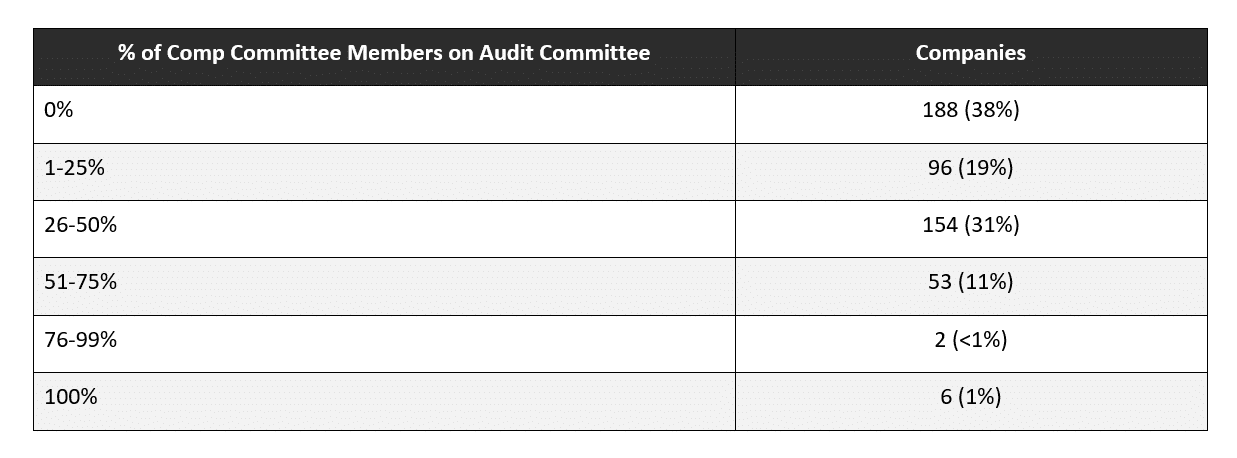
Table 1: Distribution of companies by audit/comp overlap as a percent of comp committee membership[1]
What explains these very different approaches? What are the advantages and tradeoffs?
Board size is the biggest determinant. Large boards with deep independent benches often assign each director to one major committee. With a dozen or more independent directors, a board can staff fully or largely dedicated committees. The philosophy is that depth outweighs breadth, while cross-functional issues are addressed at the full board level.
Smaller boards take a different approach. They spread the same group of independent directors across multiple committees. Their view is that overlapping membership creates synergies while avoiding the costs of expanding the board unnecessarily.
It’s not that smaller companies can’t attract qualified directors. Rather, larger companies tend to face a broader range of governance issues that all but necessitate a larger board. Some also maintain more committees (e.g., Pfizer has six), but most have only one or two beyond the audit, nominating and governance, and compensation committees.
Workload is another consideration. Both the audit and compensation committees have increasingly demanding agendas, driven by more frequent meetings and more complicated issues to untangle. Audit committees oversee quarterly reporting, meet regularly with auditors, supervise the external audit, and address risk oversight, among other responsibilities. Compensation committees now commonly meet at least six times a year, and many have expanded their remit beyond executive officer compensation to include areas like human capital management and culture.
The size data shows where double duty is most prevalent. Committee overlap is materially lower at the largest companies than at the smallest.
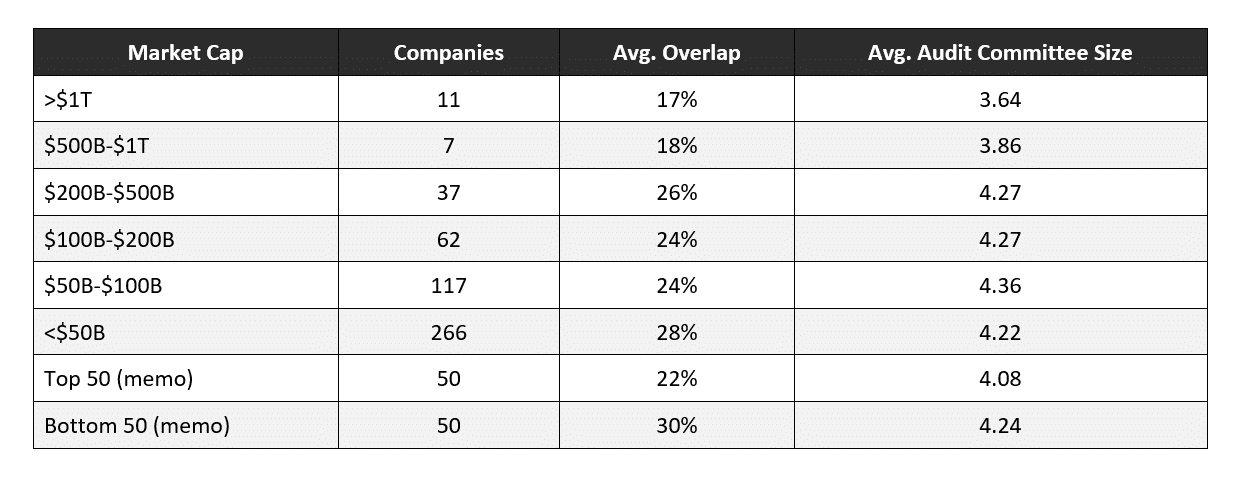
Table 2: Overlap by market cap (overlap averages exclude KKR, which has no comp committee)
The revenue data tells a similar story. Overlap averages 16% among companies with more than $200 billion in revenue, versus 26% to 29% in the two smallest revenue bands.
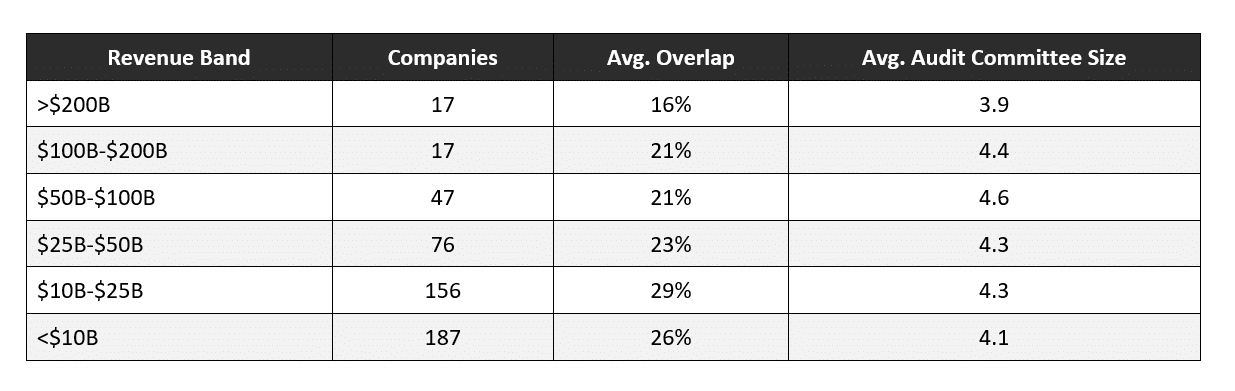
Table 3: Overlap by revenue band
Overlap varies by sector as well, though much of that variation simply reflects differences in company size.
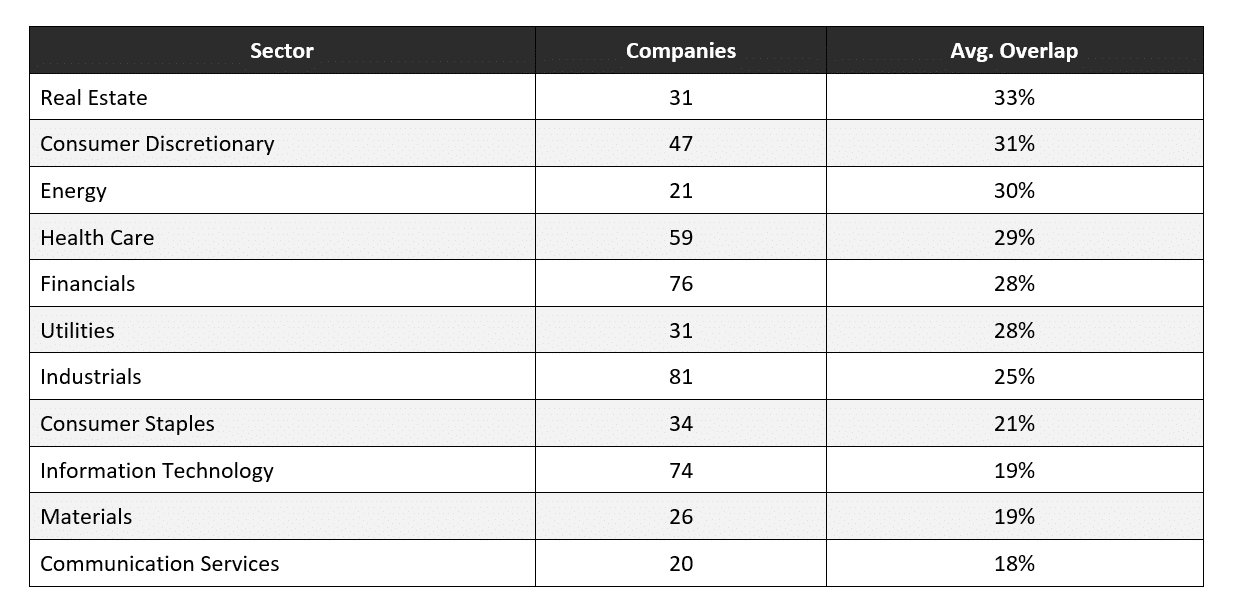
Table 4: Overlap by GICS sector
Coming back to the question that motivated this study, could aspiring CFOs and CAOs position themselves as candidates for both committees? We think the answer is yes. The size data is especially promising since most first-time board members will likely join firms outside the S&P 100, where the ability to contribute on both the audit and compensation committees is viewed as an advantage.
What about CHROs? Could they join a board even if their value proposition is mainly service on the compensation committee? Again, we think the answer is yes. Directors aren’t automatically required to serve on two committees.
For the compensation committee side of the census, we profiled every member in the index: 1,981 directors across all 500 companies. Each was sorted into one of seven career archetypes.
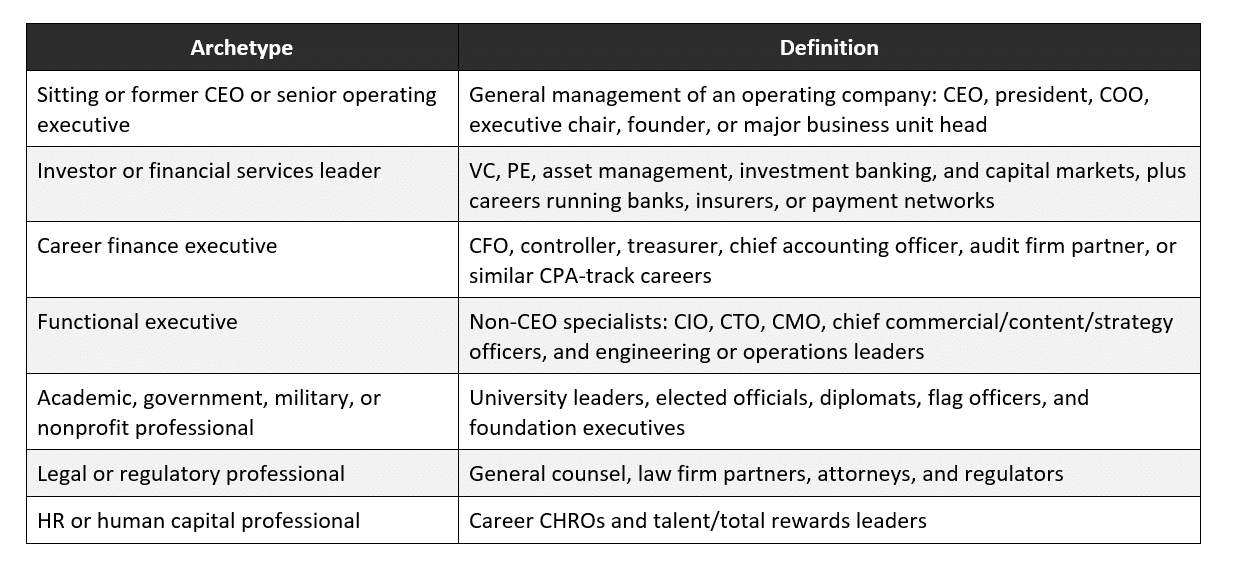
Table 5: Compensation committee career archetype definitions
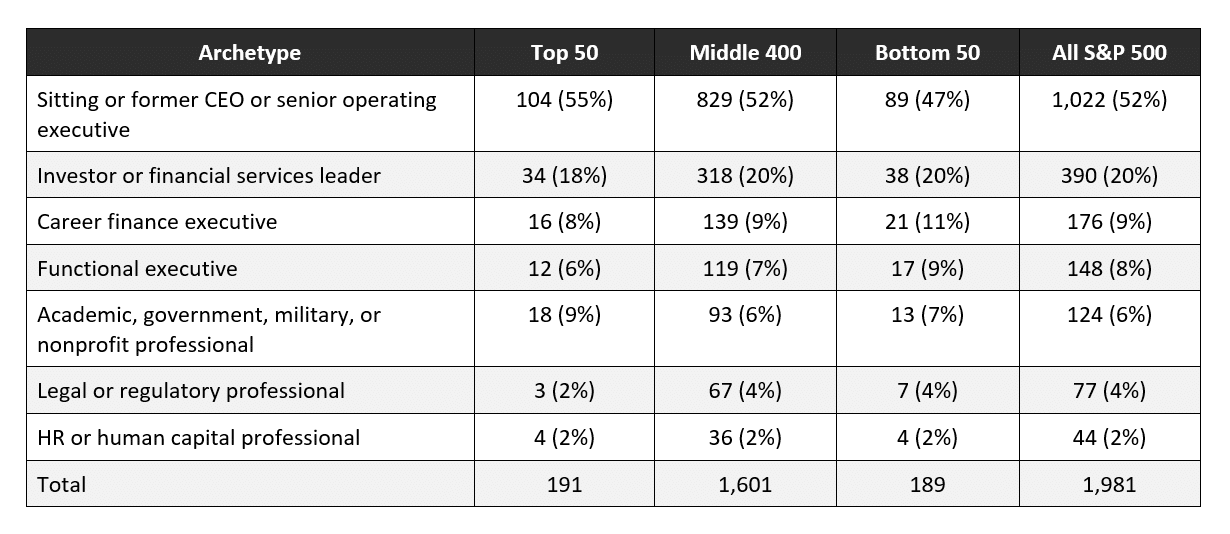
Table 6: Compensation committee archetype distribution by size band
CEOs set CEO pay. Just over half of all S&P 500 compensation committee seats (52%) belong to current or former chief executives and senior operating leaders. There’s a modest size gradient, ranging from 55% among the biggest 50 companies to 47% among the smallest 50, but nothing significant enough to change the headline. Chairs of compensation committees skew even more heavily, with 58% held by CEO-archetype directors.
The rarest resume on compensation committees is the one that matches the committee’s remit. CHROs (and similar) hold just 44 of the 1,981 committee seats in the entire index. That’s 2%, a share that’s unchanged across every size band. Only 17 of 483 compensation committee chairs (4%) are HR professionals.
Why the gulf between the finance path and the HR path? The answer comes down to what boards believe they can outsource. Boards recruit compensation committee members mainly for general business judgment, with the idea that technical expertise is something they can supplement through consultants. A CEO career signals profit-and-loss responsibility, capital allocation experience, and exposure to every major function of an enterprise.
The audit committee enjoys no such flexibility. Listing standards and SEC rules effectively require financial expertise on the committee itself, and external auditors need knowledgeable counterparts across the table. No comparable requirement exists for compensation expertise, so the perception that it can be obtained externally goes unchallenged.
Nominating and governance committees, which are also comprised largely of current and former operators, may view a traditional HR career as offering deep functional expertise without the same breadth of enterprise experience. Director nomination pipelines then reinforce the pattern, as sitting directors often recommend candidates from their own networks, and those networks are dominated by other operators.
Although the data suggests an uphill climb for seasoned CHROs looking to join a board, their present-day scarcity also presents an opportunity. A board that adds a seasoned CHRO gains someone with firsthand operating experience on strategic matters like succession planning, workforce transformation, and culture. These topics are formally or informally becoming part of the compensation committee’s remit.[2]
The importance of strategic human capital continues to grow as AI reshapes talent strategy at nearly every company. Connecting talent strategy to business strategy, planning for leadership succession, managing organizational change, and building the workforce needed for long-term success are some of the skills CHROs bring. We don’t think these capabilities are niche or easily outsourced. That’s why we see an opportunity on the horizon for a career CHRO looking to join a board.
Every proxy statement presents an audit committee stocked with financial experts. But how deep does that expertise actually run? Not quite as deep as the disclosures might suggest. That’s not a flaw, but it is an opportunity for CFOs and CAOs with deep financial acumen.
Under our strict rubric, 59% of audit committee members have a bona fide finance career background. That leaves roughly two in five seats held by directors whose careers were in operations, technology, law, or academia. Many are nonetheless designated audit committee financial experts because they managed financial executives or had exposure to financial matters.
The chair seat is where finance expertise is most concentrated. Among audit committee chairs, 89% have a finance background, compared with 59% of members overall. Boards clearly approach the chair role differently from the rest of the committee. The prevailing model seems to be a single expert who can go toe-to-toe with the auditors and the CFO, supported by generalists who bring judgment and an industry perspective.
Interestingly, the 11 trillion-dollar companies have the most finance-intensive audit committees in the index, with 74% of seats held by finance-career directors, despite having the smallest committees on average. Smaller committee, deeper financial credentials.
The census also adds context to what the modern audit committee chair looks like. The dominant archetype is a sitting or recently retired public-company CFO. Hugh Johnston (CFO at Disney) chairs Microsoft’s audit committee. Peter Oppenheimer (former CFO at Apple) chairs Goldman Sachs’ audit committee. A. Brooke Seawell (former CFO at Synopsys) chairs Nvidia’s audit committee.
Former Big Four leaders make up the second major group. Sharon Allen (retired Deloitte chairman) chairs Bank of America’s audit committee, Bob Moritz (retired PwC global chairman) chairs Walmart’s, and James Turley (retired EY CEO) chairs Citigroup’s.
The implication is that audit committee refreshment draws from a small pool of CFO-caliber directors. What does that mean for seasoned CAOs? As we’ll discuss next, they face a challenge similar to that of CHROs: showing enterprise leadership beyond their core functional expertise.
The data points to two different playbooks. CHROs must first overcome the perception that their expertise is narrowly functional and can therefore be outsourced to external advisors. We see it differently. As companies become more human capital-centric (a trend we expect AI to accelerate rather than reverse), CHROs bring mission-critical skills that make them compelling board candidates.
CFOs and CAOs, by contrast, offer skills that boards generally know they can’t outsource. Even so, it behooves finance executives to demonstrate enterprise-wide leadership beyond their core finance responsibilities. For CAOs in particular, the challenge looks more like the ones CHROs face than CFOs.
For CFOs, the audit committee is still the natural entry point, with double duty across audit and compensation committees a genuine advantage outside the mega-caps. The differentiators worth building before pursuing a board seat include broader operating responsibility (business unit or transformation mandates), investor-facing experience, and direct involvement with executive compensation matters.
For CAOs, deep technical credentials are a double-edged sword. Accounting expertise is essential, but boards may still conclude they can obtain it elsewhere. CAOs are most likely to be successful when they supplement their accounting experience with tours of duty through treasury, investor relations, and traditional FP&A (e.g., partnering with business unit executives on projections, capital allocation, etc.).
Audit committees must recruit finance expertise because their entire charter is predicated on understanding the science behind the financials. There’s no comparable mandate to wield deep compensation expertise on the compensation committee, and many boards believe their consultants can supply it on demand. As a result, CHRO candidates need to build their board case differently from CFOs.
The first priority is demonstrating an enterprise-wide purview before leaning into technical credentials and domain expertise. A rotation outside HR is one path. Another is developing close working relationships with the CEO, CFO, or other executives who will not only vouch for the CHRO’s enterprise-wide thinking, but also include the CHRO in a wider array of corporate matters. In any event, top CHROs are already involved in broader enterprise-wide initiatives. The opportunity is to make those contributions more visible when engaging with nominating and governance committees and board recruiters.
That doesn’t diminish the value of deep human capital expertise. Succession planning, change management, incentive alignment, performance management, and governance are enterprise-level capabilities that a compensation committee can’t readily outsource.
The two levers work together. Enterprise leadership helps a CHRO clear the initial screen for board service, while human capital expertise becomes a differentiator rather than a perceived limitation. And, as we’ve seen, there’s no expectation that every director serve on two committees. A value proposition anchored in the compensation committee alone can be entirely compelling, particularly as human capital and AI-era talent strategy continue to climb the board agenda.
Audit committees didn’t always rely so heavily on finance careers. It took the Sarbanes-Oxley Act and the listing standards that followed to make financial expertise a structural requirement. Two decades on, that requirement has produced the deep bench of finance leaders we measured.
Today’s compensation committee looks a lot like the pre-SOX audit committee in one important respect: It’s staffed with experienced operators who supplement technical expertise with outside advisors.
Nothing on the horizon mandates compensation expertise the way SOX mandated financial expertise. But mandates aren’t the only force that changes board composition. Whether formally or informally, compensation committees are taking on responsibilities that extend well beyond executive compensation and proxy oversight. Culture, workforce readiness, and aligning talent strategy with business transformation are increasingly part of the discussion. AI is accelerating that evolution.
If the compensation committee’s responsibilities keep expanding, demand for directors with CHRO-type experience will grow. Even if they don’t, CHROs are already leading enterprise-wide initiatives that demonstrate the strategic perspective boards increasingly value.
That’s why the 2% figure is best read as information rather than a verdict. For the clients and colleagues who encouraged us to undertake this study, and who hope to contribute in the boardroom later in their careers, we believe the capabilities you’re developing today will become increasingly valuable in the years ahead.
Universe. We began with the current S&P 500 constituent list. The companies range from Nvidia, with a market capitalization of $4.72 trillion, to Mosaic at $6.7 billion.
Board committee rosters and director backgrounds were verified against each company’s most recent DEF 14A proxy statement, covering 494 companies. Six companies do not file a conventional annual meeting proxy: Blackstone, KKR, Erie Indemnity, and the recent spin-offs Honeywell Aerospace, FedEx Freight, and Paramount Skydance. For those companies, we relied on Form 10-K Part III disclosures, Form 10 information statements, or DEF 14C filings. Directors identified as not standing for reelection were excluded.
Finance background rubric. A director was classified as having a finance background only if their resume reflected a career in a finance function. This is a higher bar than the SEC’s definition of an audit committee financial expert. Qualifying careers include:
Overlap metric. We measure committee overlap as the number of directors who serve on both the audit and compensation committees divided by the size of the compensation committee. We chose the compensation committee as the denominator, although using the audit committee would produce similar results.
Compensation committee archetypes. Each compensation committee member was assigned to one of the seven career archetypes defined in Table 5 based on their dominant career identity. When a director fit multiple archetypes, the current role—or, if retired, the most senior sustained role—served as the tiebreaker.
****************************************************
[1] The population is 499 companies because KKR doesn’t have a compensation committee. All subsequent tables involving compensation committee analysis are based on the same denominator.
[2] Many compensation committees are formally revising their charters to encompass human capital management as a whole, instead of merely executive pay setting and proxy review. But even those whose charters are staying the same are increasingly talking about strategic human capital issues outside the C-suite.