Subscribe to Our Newsletter
Hear more from Equity Methods: Your trusted partner in equity compensation excellence.

A moonshot grant (sometimes called a mega grant)[1] is an extraordinarily large, one-time equity grant issued to a CEO or other top executive. These grants tend to be much larger than annual awards and feature ambitious performance targets designed to link outsized executive rewards with outsized shareholder outcomes.
Moonshot grants are also one of the most highly charged areas of stock-based compensation. They tend to accompany pivotal moments in a company’s life: IPOs, major executive hires, strategic transformations, and the like. Successful or unsuccessful execution of these grants can dramatically alter the operating environment for the next several years of executive compensation. On top of that, they can attract unwanted attention in the press, and they’re heavily scrutinized by shareholders and proxy advisors.
Given the stakes, there’s no shortage of commentary on moonshot grants. Some of it is excellent, some should be taken with a tablespoon of salt, and much of it falls somewhere in between. Here, we focus on some of the key considerations.
To bring an empirical perspective to the discussion, we collected data on moonshot grants made from 2020 to mid-2025, based on proxy filings available through the first half of 2026. In our June webcast, we presented an initial set of findings from the dataset. Below, we revisit a few of them and share some new findings.
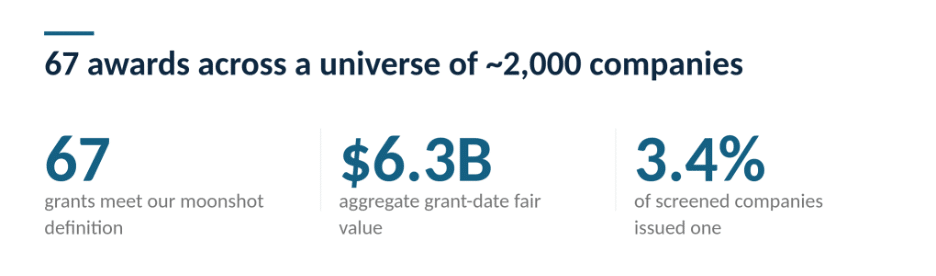
Our dataset includes 67 moonshot grants from between 2020 and 2025, with an aggregate grant-date fair value of $6.3 billion, identified from a universe of approximately 2,000 of the largest companies. Among the companies we screened, only 3.4% issued a moonshot grant over a roughly 4.5-year period.
By definition, moonshot grants are unusual. In any given year, fewer than 1% of companies issue one, so even a thorough dataset will be relatively small. That said, companies often look to precedent when designing these awards. Historical grants can therefore provide useful insight into how moonshot awards have been structured and how they have fared.
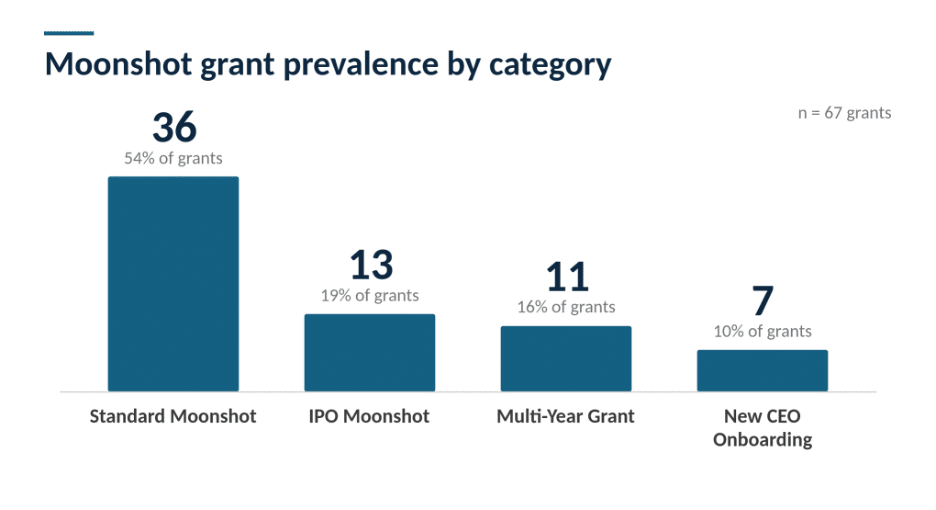
The grants in our dataset also reflect a range of circumstances. Just over half are standard moonshots, a catch-all category that includes awards for purposes like CEO retention, strategic transformation, and long-term incentive (LTI) reset and alignment. The remainder includes IPO moonshots, multi-year grants, and awards made in connection with the onboarding of a new CEO.
Those circumstances can have a significant impact on award design. Consider IPO grants. Their median value aligns with the full sample ($60 million versus $58 million). But the difference is much larger when looking at the mean: $155 million for IPO grants versus $93 million for the full sample.
Narrowing the peer group to create a more like-for-like comparison reduces an already small sample. Depending on the design decision, that narrower comparison may matter a lot or not much at all. The key is knowing when a smaller, more targeted sample provides better insight and when a broader sample provides a more useful basis for comparison.
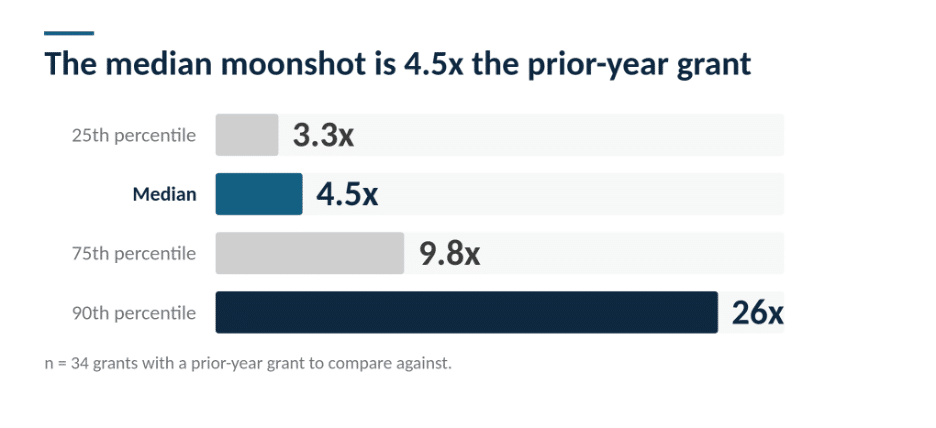
The range between the 25th and 75th percentile multipliers tells part of the story about moonshot grant sizing. The extreme upper end tells the rest. At the 90th percentile, the moonshot grant is 26 times the size of the prior-year grant.
Further, the sub-sample for this statistic only looks at cases with a prior-year grant. This naturally excludes almost all new IPO and new CEO moonshot grants, which tend to be larger, on average, than standard and multi-year grants.
Alongside goal setting, grant sizing is one of the most important design decisions, and practices vary widely. Common factors include:
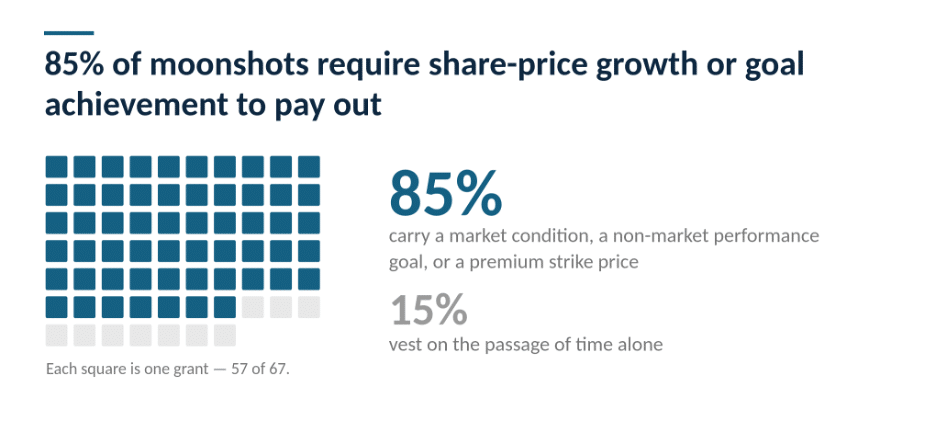
The 85% figure is unsurprising. Robust performance requirements are usually a prerequisite for an award of this magnitude. The rationale for a moonshot grant is to create significant at-risk compensation tied to ambitious outcomes while aligning the executive’s incentives with those of shareholders. Without a meaningful performance requirement, justifying the award to shareholders gets much more challenging.
The residual 15% is also noteworthy. Although uncommon, some moonshot awards rely entirely on time-based vesting. In those cases, the vesting period is typically much longer than for an ordinary LTI award, often extending five years or more.
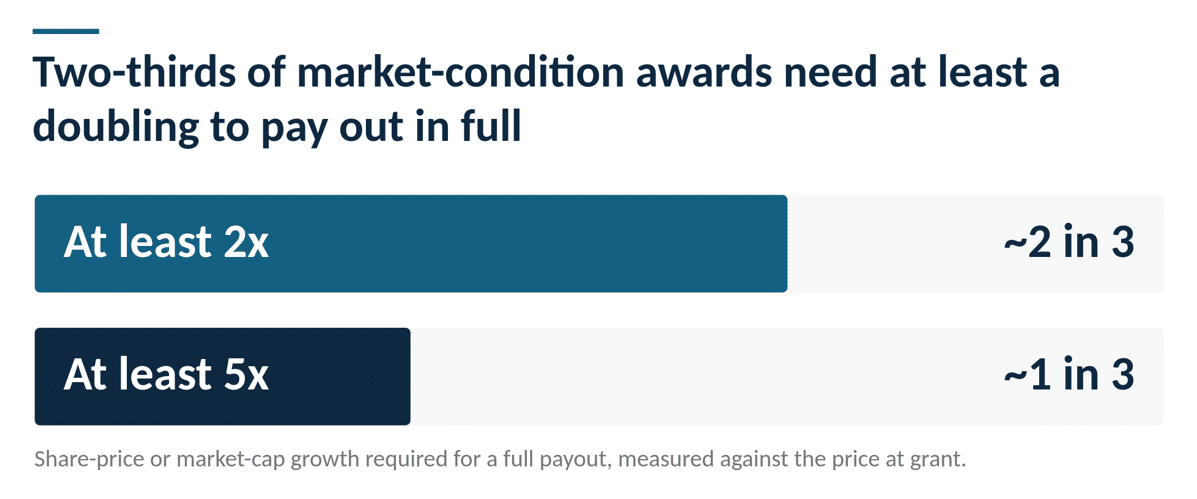
Performance goals are not only prevalent, they tend to be more ambitious than those used in typical LTI programs and measured over longer time horizons. Among awards with market conditions, roughly two-thirds require the share price or market capitalization to at least double for a full payout, while 30% require growth of at least five times the value at grant.
One common way companies calibrate and explain the size of these awards is by comparing executive pay outcomes with shareholder outcomes using what’s commonly called a sharing ratio. A $100 million payout can give shareholders significant sticker shock. But if that payout represents 1% of the shareholder value created when the goals are achieved, the business case for the outlay becomes much clearer. Share-price goals make it possible to establish that relationship explicitly.
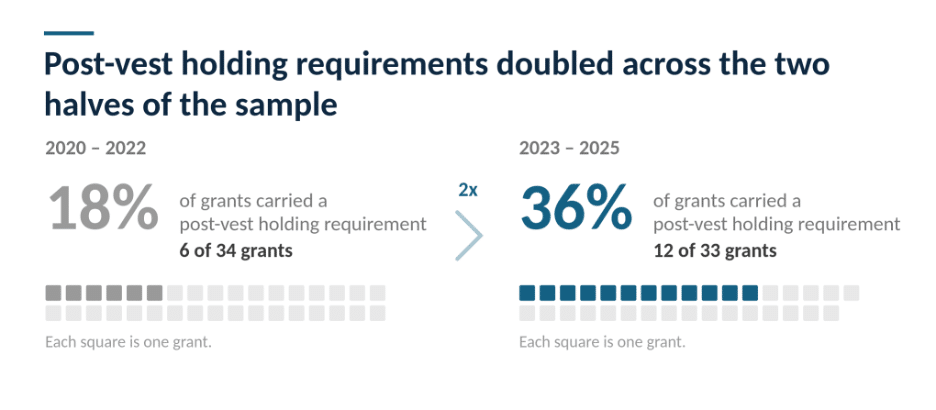
Given the limited sample, we would caution against drawing precise conclusions from these percentages. Still, the direction is notable: Post-vest holding requirements appeared in 18% of grants from 2020 through 2022 and 36% from 2023 through 2025. That’s consistent with the broader trend we’re seeing across the LTI landscape.
Post-vest holds offer several benefits for moonshot awards:
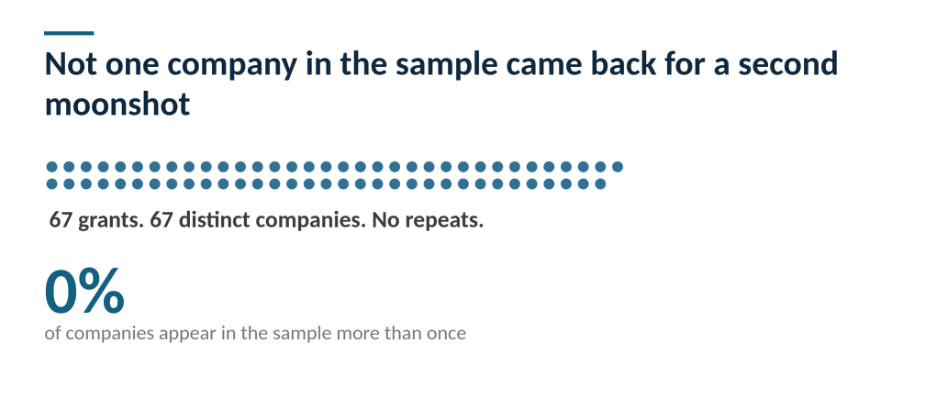
Our 67 grants span 67 different companies. That makes sense given that moonshot awards are intended to span a much longer period than typical LTI awards, while our sample covers only about five years.
Still, the finding underscores the point that companies don’t get a second bite at the apple, at least not for a long time. Careful design and goal setting are only half of the battle. Companies also need to understand the risks at the outset and plan for the range of outcomes that could unfold over the life of the award.
One famous semi-exception outside our sample is Tesla. The company made moonshot grants to its CEO in 2012 and again in 2018. But 90% of the 2012 grant had been earned before the second grant was issued. So while the 2018 award was technically a repeat grant, we’d consider it a new apple (to extend the metaphor) rather than a second bite at the first.
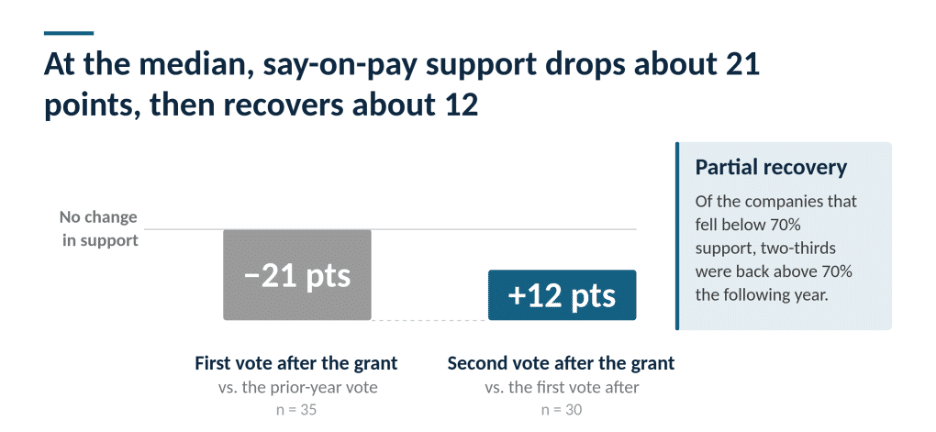
A moonshot grant typically comes with a say-on-pay hit. The more interesting questions are how large that decline tends to be and how quickly recovery takes place. At the median, say-on-pay support falls 21 percentage points in the first vote after the grant, then recovers 12 points in the following year. Among companies that fall below 70% support, about 70% move back above that threshold the next year.
From our perspective, companies should understand say-on-pay risk during the planning process, but it shouldn’t override the business rationale for the award. Pre and post-grant shareholder engagement, along with the passage of time, have a strong track record of helping support recover.
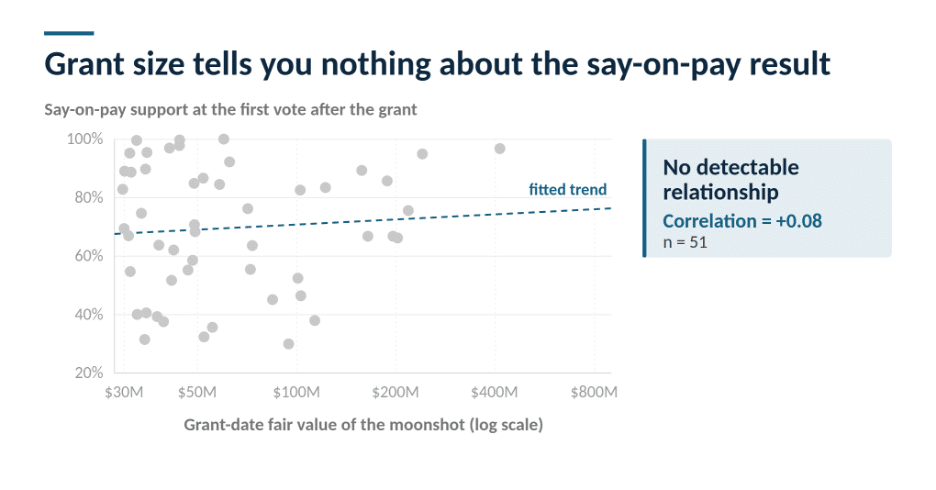
The data also suggests that the say-on-pay penalty is driven more by the decision to issue a moonshot grant than by the size of the grant itself. In our sample, grant size had essentially no relationship with say-on-pay support at the first vote after the award. This stands to reason because any moonshot award is going to place a company toward the upper end of the pay range in a pay-versus-performance or benchmarking analysis. Shareholders may react to the level of compensation itself or to governance concerns around the process and rationale, rather than to whether the grant was somewhat larger or smaller.
That finding comes with two important caveats. First, it’s not an argument for scaling grants up indiscriminately. Companies still need data and a compelling rationale to support grant sizing. But once the grant size is well justified, say-on-pay considerations should probably become a secondary concern.
Second, the finding says nothing about the other design features of a moonshot award. Our sample isn’t large enough to draw statistical conclusions about factors like vesting conditions or goal rigor, but we would expect these features to influence shareholder support.
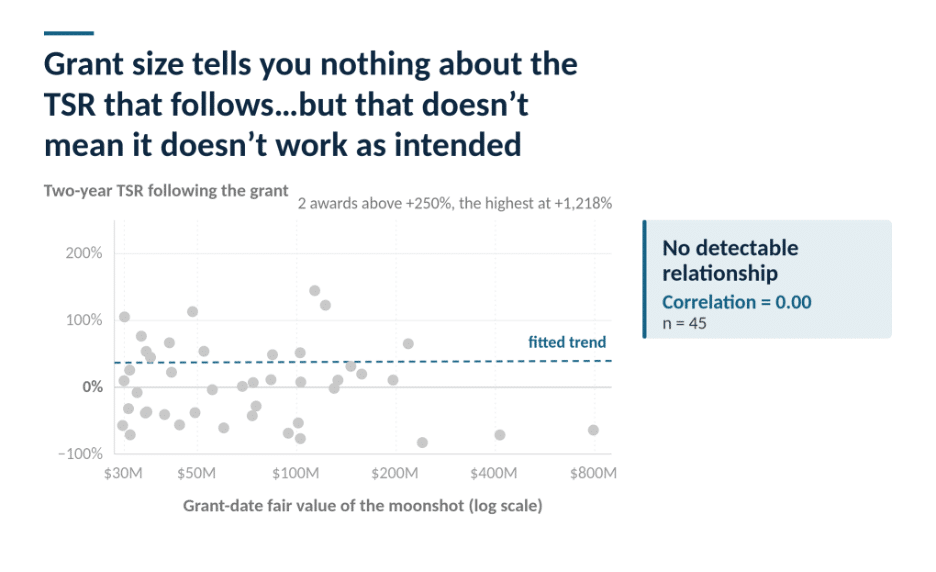
Grant size also tells us very little about the TSR that follows. In our sample, the correlation between grant size and two-year TSR was 0.00 (shown above), and the correlation with one-year TSR was +0.04. In other words, there was no detectable relationship.
That doesn’t mean moonshot grants don’t work. No equity grant can directly cause stock outperformance, and they aren’t designed to. If issuing a moonshot award were enough to boost the share price, everyone would do it.
The purpose of a moonshot award is instead to create much greater leverage between pay and performance than a traditional LTI award. A standard LTI program often includes restricted stock units, which retain some value even when performance is weaker, as well as performance stock units with a more modest maximum payout. Annual grants also spread exposure across multiple entry points over time.
A well-designed moonshot grant steps outside of these bounds. It offers extraordinary upside if ambitious goals are met, while putting substantially more compensation at risk if they aren’t.
Notably, if we focus on only moonshot grants with a new CEO onboarding, there’s an excellent TSR story: median performance is +41% after one year and +64% after two years. This doesn’t imply that the award causes the performance, of course, but suggests those situations may be a particularly effective use case for a moonshot grant.
None of the figures above should be treated as a benchmark or how-to guide. The sample is small, the fact patterns vary widely, and any company issuing a moonshot grant is almost by definition doing something its peers are not.
What the data does provide is useful context for design decisions. Performance conditions are effectively table stakes, with goals typically set well above ordinary LTI watermarks. Post-vest holds have mirrored the upward direction we see in the broader market, but at a faster pace.
The one-off nature of moonshot grants puts a premium on getting the design right, as well as on being ready to respond if goals are achieved much sooner than expected or start to drift out of reach.
If you’re considering or already planning a moonshot grant, we can help you design the award and manage it throughout its lifecycle. Reach out to learn more.
****************************************************
[1] We define a moonshot grant as a total grant (including stock and options) of $30 million or more that represents either a substantial (greater than 50%) spike in value relative to the prior-year grant, or, in cases with no prior-year grant (e.g., IPO or new-CEO awards), a total value of $30 million or more.