Subscribe to Our Newsletter
Hear more from Equity Methods: Your trusted partner in equity compensation excellence.

When a company needs cash before it’s ready for a priced round, a common solution is to issue a convertible bridge note or simple agreement for future equity (SAFE). Both let the company raise cash now, bridging the gap to its next financing. A convertible note is debt that accrues interest, has a maturity date, and can convert into equity. A SAFE, on the other hand, settles in equity or cash at a liquidity event without any interest or maturity.
The two instruments can carry similar commercial features. Investors commit capital before the company has set a share price and often have less information than investors in the later priced round. Some features compensate them for that risk by affecting how much equity they receive at conversion. Others spell out what happens if the expected financing is delayed or the company is sold. Here’s how the most common features work and what each means for the company and its investors.
The discount is typically a core term of a convertible note and almost always present. It gives the bridge investor a lower price per share than the new investors in the next round, usually expressed as a percentage off the round price. A 20% discount on a $1.00 round price lets the bridge investor buy that share for $0.80. It’s a straightforward way to reward investors for taking on the additional risk of committing capital before a priced round. Discounts vary – a company facing a cash crunch may offer a more generous discount than one with several term sheets on the table. Still, 20% is a figure we commonly see across deals.
Note that a discount is a fixed benefit providing a fixed dollar value. With a 20% discount on a $1 million note, a round priced at $1.00 per share means the note converts at $0.80. The investor receives 1.25 million shares worth $1.25 million at the round price. If the round is priced at $10.00, the note converts at $8.00. The investor receives 125,000 shares, again worth $1.25 million at the round price.
The remaining features layer on top of this baseline. They can give investors more exposure to the company’s upside or compensate them for a longer wait. They can also provide downside protection or value in alternate scenarios.
A discount gives bridge investors a better entry price. A valuation cap can give them a bigger share of the upside if the company grows substantially before the priced round.
Valuation caps set a ceiling on the valuation at which the note or SAFE converts, regardless of where the priced round actually lands. For example, a SAFE with a $5 million cap that converts against a $20 million pre-money round converts as though the company were worth $5 million. That means the investor gets roughly four times the equity that someone investing in the new round gets for the same investment. The cap benefits the bridge investor if the company overperforms before the priced round. When both a cap and a discount are present, the investor converts at whichever produces the lower price per share, so the cap applies only when the round price is high enough to make choosing the cap the better deal.
Issuers should treat the cap, not the headline investment, as the number that sets dilution. A $500,000 investment at a $5 million cap can end up costing more equity than a $2 million investment at a $20 million cap if the company’s value gets much higher than $5 million before the next financing. For example, if the company value is $25 million, then both caps are met and both types of investors can buy 10% of the company ($500,000/$5,000,000 or $2,000,000/$20,000,000). However, those making the first type of investment get 10% of the company for a significantly lower price.
That potential upside is also why investors negotiate hard over the cap. A low cap on a fast-growing company can produce dilution well after the issuance of the instrument. And once the next round closes and the conversion price is fixed, there aren’t many chances to renegotiate.
Table 1 walks through the effect of the cap and discount, using these assumptions:
In the table, the effective valuation reflects the cap or discount. The ownership figure is calculated by dividing the $500,000 investment by that effective valuation.
In the final row, the 20% discount brings the $20 million round valuation down to $16 million. But the $5 million cap gives the investor a much lower conversion price, so the cap wins. That’s why the last two rows are identical. Adding the discount gives the investor nothing extra.
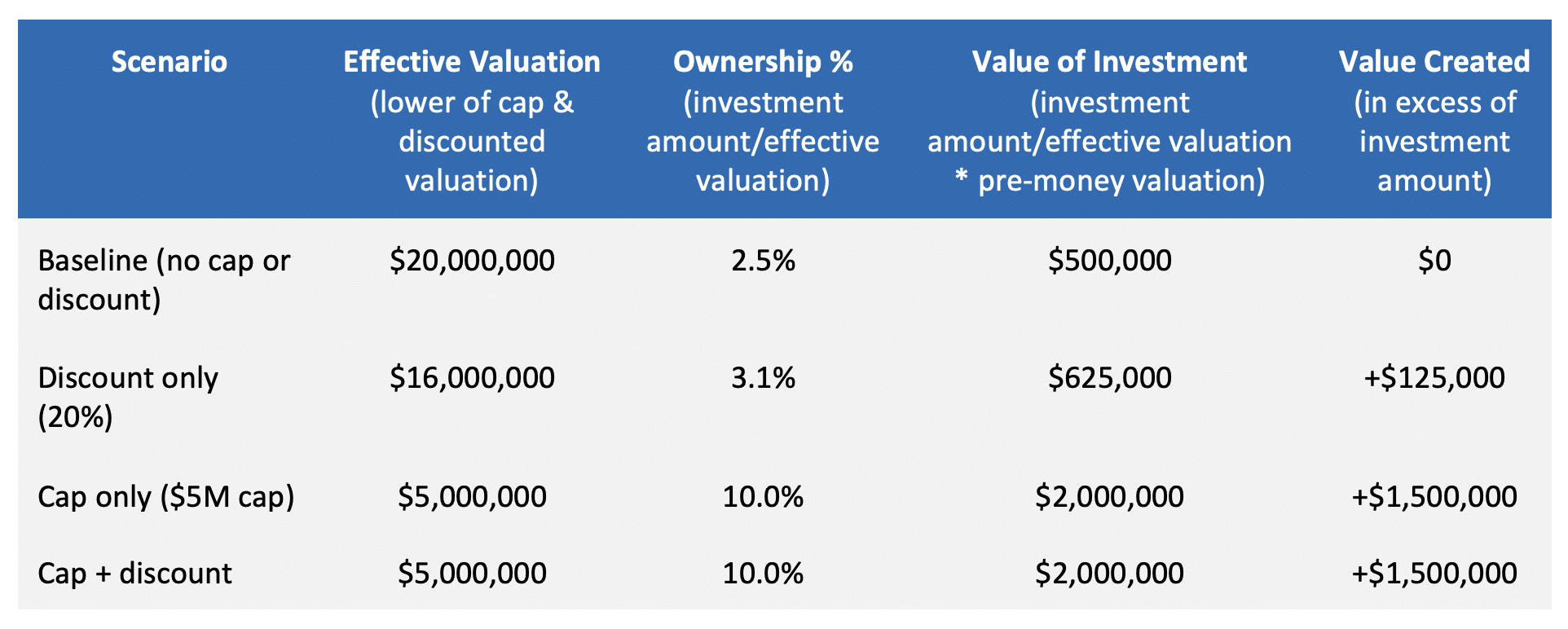
Table 1: Example of effective valuation, ownership, and value created on a $500,000 investment
A floor, on the other hand, sets a minimum conversion price. A note or SAFE may convert at the lower price implied by its cap or discount, but not below the floor. In a down round, a floor can keep a discount from pushing the conversion price below an already depressed round price. Without the floo›r, the holder could end up with equity that’s difficult to sell without accepting a sizeable discount.
If the calculated conversion price falls below the floor, a convertible debt holder’s best move is to decline conversion and stay a creditor. This is also a good move for SAFE holders, but the liquidation priority is often on par with the rest of the preferred shares, and junior to other types of debt. This move preserves a claim ahead of junior equity holders if the company faces a distressed sale or wind-down. Floors show up less often than caps or discounts, typically when the parties are specifically concerned about a future down round.
Interest rates and maturity dates apply only to convertible notes and work much as they do with other debt. Interest on a convertible bridge note typically accrues rather than being paid in cash. When the note converts, the accrued interest converts into shares along with the original principal. A note outstanding for two years at 6% simple interest converts about 12% more principal than the investor actually invested, which is a modest but real cost if the bridge stays open for an extended period.
The maturity date becomes important if the note hasn’t converted by then. The note is due, but cash repayment rarely happens in practice, since a company that couldn’t raise a priced round usually can’t repay the notes either. The parties may instead negotiate an extension, a set conversion price, or better economics than the original note carried. At that point, the noteholder has leverage because the company needs more time. For the issuer, the best protection is to plan for the possibility that the next financing takes longer than expected, before reaching maturity with few options.
If the next priced round is still some time away, early investors may worry that the company will offer better terms to investors who come later. A most-favored-nation (MFN) clause lets them adopt those terms if the company issues another bridge instrument on more favorable conditions. This can be useful when a company raises bridge financing in stages over several months.
For example, a company might set a valuation cap to bring in its first investors, then offer a lower cap a few months later to attract additional capital. With an MFN clause, the early money’s terms improve automatically to match the lower cap from the latest issuance. An MFN clause has no cost to the issuer unless the company later offers a better deal, and that protection can make the earliest investors more comfortable committing capital.
Although investors expect these instruments to convert into equity, the company may be sold or wound down before its next priced round. Change-in-control and dissolution provisions specify what investors receive if that happens. Common structures include a repayment multiple, a payment equal to a multiple of the original investment, or a right to receive the acquirer’s stock or cash proceeds as though conversion had already happened. These provisions protect the investor in a scenario the discount, cap, and floor were never designed for. A clean, well-drafted change-of-control provision also helps issuers by showing prospective acquirers how outstanding bridge notes would be handled in a sale.
For some convertible notes, change-in-control provisions often call for payments above 150% of a note’s principal, and 300% is not uncommon. These potential payouts can become part of the sale negotiations, giving noteholders leverage in the deal.
No single note or SAFE carries every feature discussed above. Most bridge rounds settle on the protective terms the specific deal calls for. Stacking every feature onto a single note or SAFE would be unusual and may indicate that the investor had most of the leverage.
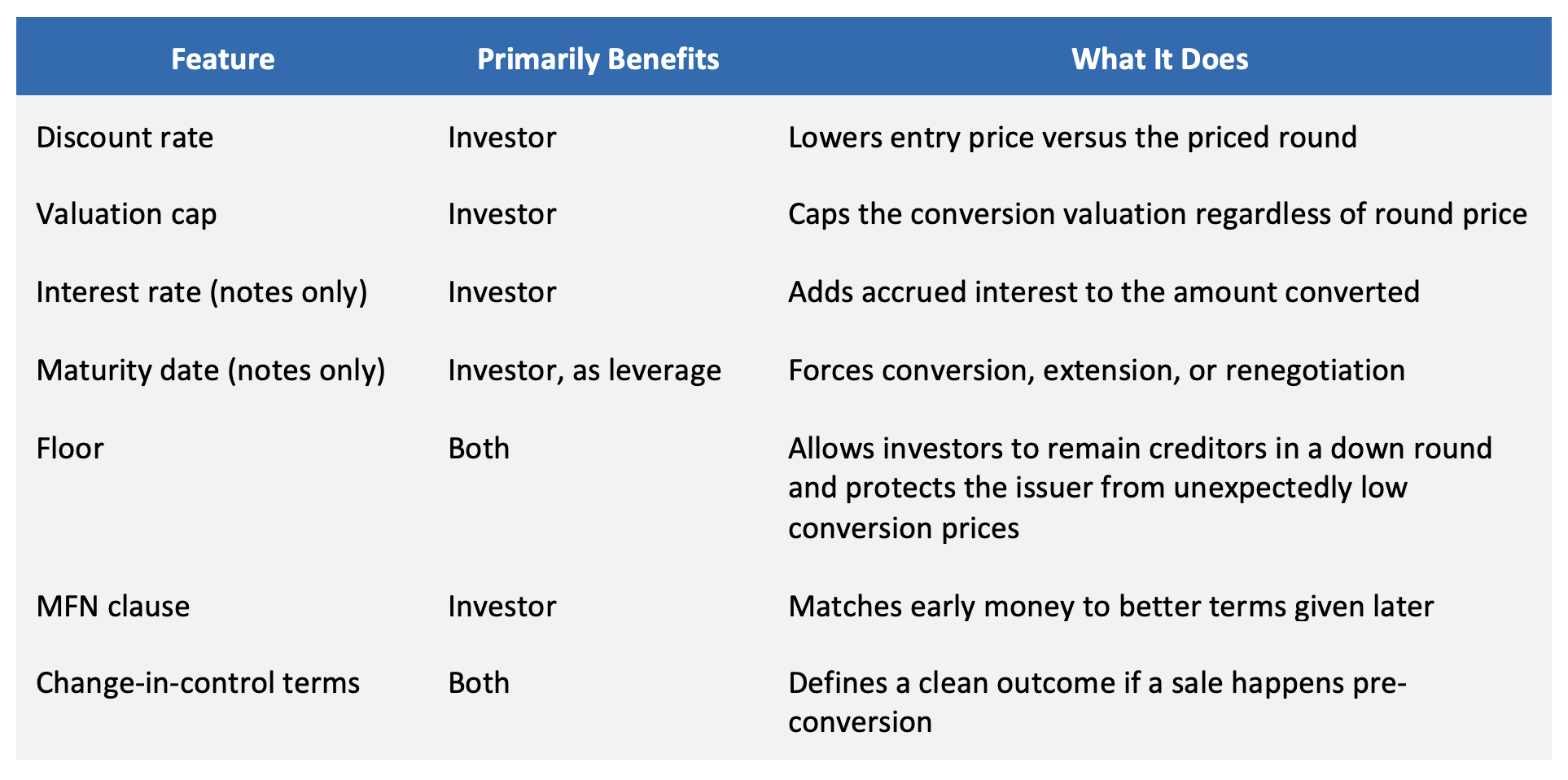
Table 2: Typical beneficiary and mechanism by feature
These instruments and their terms carry real accounting consequences. A SAFE may be classified as a liability or equity under ASC 480 and ASC 815-40. That assessment can depend on whether the cap or discount is more likely to determine its conversion price.
For a convertible note, the conversion feature must be evaluated under ASC 815-15 to determine whether it needs to be accounted for separately as an embedded derivative. A cap, discount, or floor embedded in the conversion terms is exactly the kind of feature that can affect that evaluation and how the note is accounted for under ASC 470-20. For more on the accounting and valuation of these instruments, see our issue brief on convertible bridge notes.
There’s no standard set of terms for a bridge round. The right combination depends on the company’s circumstances and negotiating position when it needs funding. A company with strong momentum and multiple interested investors can often get away with a higher cap, no discount, and relatively few additional protections because investors are competing for a place in the round. A company nearing the end of its cash runway is in a different position, and may be looking at a lower cap paired with a larger discount. It may also need to accept protective terms it would otherwise have negotiated away.
The terms can affect the company long after it receives the cash. Before issuing a SAFE or convertible bridge note, companies should consider how the terms could affect dilution and what happens if the expected financing is delayed. If you’d like to discuss how these features may apply to your situation, please feel free to reach out.