Subscribe to Our Newsletter
Hear more from Equity Methods: Your trusted partner in equity compensation excellence.

On November 13, the SEC released its proposed rule on executive compensation disclosure reform.[1] This undertaking dates back to the SEC’s public roundtable in June 2025 and a lengthy comment period. At 542 pages, it would rework nearly every part of the proxy’s compensation section.
The headline is a substantial reworking of the various proxy tables wherein the eight standard tables[2] required today are streamlined down to three, and the requirement to disclose on five named executive officers (NEOs) gets reduced down to two.
There’s a lot to like in this proposal, which reflects some of our thinking that more decision-useful information could be delivered with less complexity if the focus were on the lifecycle of pay from inception to completion. At the same time, and in keeping with this being a proposed rule, there are areas where we think the final rule could (or should) take a different approach to reduce the risk of confusion and misinterpretation.
In this article, we walk through the key changes. We’ll share some thoughts on a few areas that deserve a closer look, but remember that this is merely a proposal and not a final rule, so in reality, the final rule will likely contain many revisions.
As anyone who has watched the SEC’s rulemaking before knows, there are several steps between a proposal and a rule that’s in effect:
Obviously, nothing is going into effect for the 2027 proxy season that reports on 2026 pay. The 2028 proxy season may also be off the table as a requirement, since, as written, a final rule published in 2027 would take effect on January 1, 2028, and first apply to 2028 pay, which is reported in the proxy filed in 2029.
Here we’ll cover some of the more salient dimensions of the proposed rule. We’ll reserve most of our commentary for the sections that follow.
The current rules require disclosure for the principal executive officer (PEO), the principal financial officer (PFO), and the three other most highly paid executive officers, plus up to two more who would have made the list had they still been serving at year-end. That’s typically five people or more.
Under the proposal, the NEO group would be just the PEO and the PFO for every company, including smaller reporting companies and emerging growth companies. Anyone who held either seat during the year counts, so interim and co-CEOs would still be covered.
This isn’t confined to the three new tables. The smaller group carries through most of Item 402, which means the CD&A, the Pay vs. Performance (PvP) disclosure, and the clawback disclosure would all be built around two people. It also reaches beyond the compensation section. The say-on-pay vote is a vote on NEO pay, the Form 8-K triggered by a material change to an NEO’s compensation arrangement is tied to the same group, and so is the person-by-person stock ownership table.
The SEC’s reasoning is that the PEO and PFO are the two roles that matter most to investors, and that covering additional executives based solely on their pay level adds length and cost. Companies that want to keep showing other executives in the three tables could do so voluntarily without turning them into NEOs.
Now let’s turn to the tables. Three new tables would replace the Summary Compensation Table, the Grants of Plan-Based Awards Table, the Outstanding Equity Awards at Fiscal Year-End Table, the Option Exercises and Stock Vested Table, and the PvP Table. The Pension Benefits Table and the Nonqualified Deferred Compensation Table would be eliminated outright. The Director Compensation Table, the eighth, would lose its prescribed format.
Figure 1 shows the before and after.
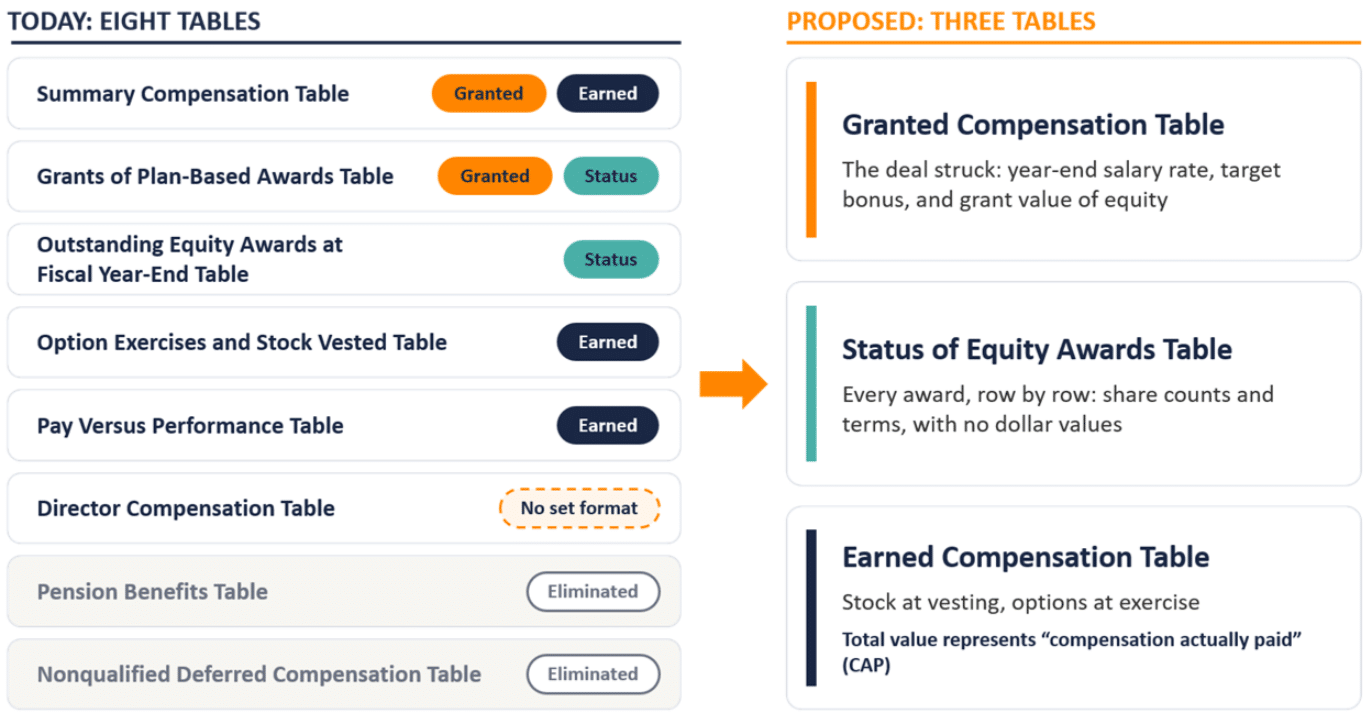
Figure 1: From Eight Tables to Three
Table 1 then summarizes what each new table would show and how it would be measured.
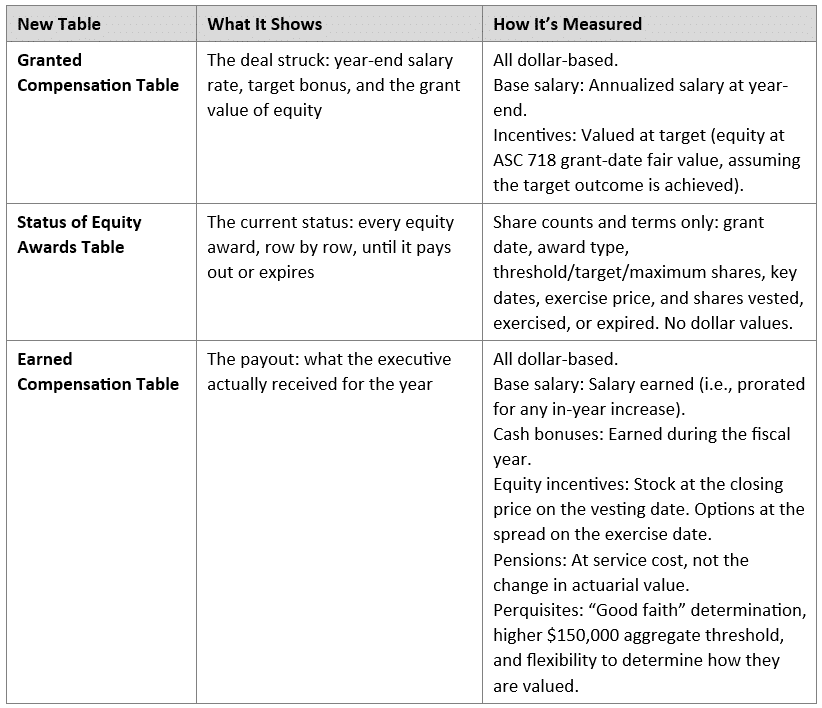
Table 1: The Three Proposed Tables
The SEC describes the Status of Equity Awards Table as a way to “bridge the gap” between the other two by tracking each equity award from the year it first appears as granted until it has been earned or has expired.
The two dollar-based tables would cover three years (two for smaller reporting companies and emerging growth companies).
We found the target requirement for the Granted Compensation Table to be quite peculiar, though, as we discuss below, it may indeed create an opportunity for more creative and bold award design. Today, the Summary Compensation Table carbon copies over the ASC 718 grant-date fair value used in the financials, meaning that awards with market conditions reflect their aggregate value at grant and awards with performance conditions are shown at the stock price times the probable outcome at grant.
Under the proposed rules, everything gets reported at target. The rule text in Item 402(c)(2)(v) states:
For awards of stock granted during the covered fiscal year, the aggregate grant date fair value computed in accordance with FASB ASC Topic 718, except that it must be assumed that the award’s target outcome(s) will be achieved (column (e)).
This is impossible for market-based awards, because the entire ASC 718 framework blends outcomes into a single probability-weighted value. However, pages 65–66 of the proposed release, as well as the actual proposed language on page 496, elaborate on the exception case applied to market-based awards. Specifically, the SEC instructs registrants to use the 100% “target” outcome for ordinary awards with a threshold, target, and max framework, and to assume achievement for binary awards that are either 0% or 100% earned:
Instruction 3 to Item 402(c)(2)(v) and (vi). Report the grant date fair value based upon the target outcome(s) of the performance, market, and/or service conditions (if applicable). For equity awards with multiple potential outcomes (e.g., minimum, target, and maximum), the target outcome is the achievement of the target outlined in the award at the 100 percent level. For equity awards that have a binary outcome (i.e., awards that are either fully earned or not earned at all), the target outcome is that the award criteria are met and the award is fully earned.
The proposed rule is trying to avoid using accounting fair values in the tabular disclosures. This seems to be a cure in search of a disease, since valuations are already being performed for financial accounting purposes and they have the effect of smoothing dispersed potential future outcomes into a blended present-day result. But as we discuss throughout this article, if the proposed rule does go through, it may incentivize something we’ve been proponents of, which is awards with much higher upside opportunity.
The PvP disclosure would get a major trim. “Compensation actually paid” (CAP) would be redefined as the total from the Earned Compensation Table, so the year-end fair value remeasurement of unvested awards would no longer be required. Company TSR would be the only required performance measure. Net income, peer group TSR, and the tabular list of most important measures would be dropped, and the company-selected measure would become optional.
The lookback would shrink from five years to three to align with the Earned and Granted Compensation Tables, and the prescribed table would give way to “a clear description of the relationship” between earned pay and TSR. Also remember that in a separate proposal, the SEC is looking to exempt all non-accelerated filers from any PvP disclosure responsibility.
The rest of the release is a long list. Here are the changes we think matter most:
The proposed rule is a mixed bag. Let’s start with what seem to be some clear positives.
Separating the deal from the outcome. Today’s Summary Compensation Table combines pay that was earned during the year with pay that was granted and may never be earned, and then adds them into one total. The strongest manifestation is that cash bonuses show up as earned while equity shows up as granted. Under the proposed rules, the Granted Compensation Table would show both at target, which allows the Earned Compensation Table to pick up the outcome in the year in which it transpires.
Putting granted and earned pay in separate tables brings an end to something that has perplexed and frustrated both boards and investors for years. Our strong view has been that it’s both easy and value-relevant for investors to understand, separately, what was granted and what was realized.
An award-by-award view. The SEC made improving “investors’ ability to track equity awards through their lifecycle” a stated goal of the proposal. A single table that follows each award from grant to payout is the right instinct. (We do, however, think that merely listing the shares without any framework for assessing the likelihood of achievement is akin to showing a sports team’s midseason schedule without showing its current win-loss record.)
A leaner PvP disclosure. Net income, peer TSR, the tabular list, and the averaging of the other NEOs added length without adding much insight. We suggested dropping these “spare parts” in our comment letters as we believe they obscure the one thing that really does matter: how actual pay conforms to actual performance.
Fewer NEOs. Disclosure would cover only the PEO and PFO. While this shrinks every table and we advocated for cutting down to the people investors actually care about, some consideration will need to be given to President, Executive Chairman, and other important but non-standard roles.
A shorter CD&A. Three required topics would take the place of seven, and the list of 15 example topics would go away.
An overhauled perquisites framework. The reporting threshold would rise from $10,000, a level that hasn’t been updated since 2006, to $150,000. Furthermore, the company would get the call on what counts as a perk in the first place. If it reasonably concludes in good faith that an item is “integrally and directly related to the performance of the executive’s duties,” that item would not be a perquisite at all.
A more comparable pay ratio number. While not much has been made of the pay ratio number, we note that foreign and part-time employees have produced some headline numbers that required more complex storytelling. Using only full-time US employees, while not perfect, may give a more apples-to-apples comparison.
If the proposed rule is a mixed bag and the prior section covers some clear positives, here we discuss provisions that could prove to be limitations or opportunities for companies.
When the SEC writes “the target outcome is the achievement of the target outlined in the award at the 100 percent level,” it presupposes that “target” and “100%” are stable outcomes. They’re not; they’re byproducts of today’s overly homogenized award design framework that pegs threshold at a 0% payout level, max at 200%, and target in the middle at 100%.
How about an outcome like:
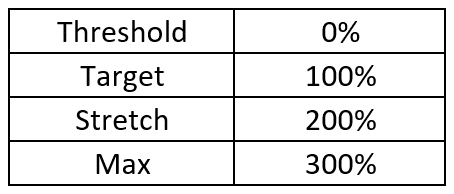
While the goal is not obfuscation, and proposed Item 402(a)(5)(i) introduces a principles-based bar for disclosing supplemental detail, a structure like the above would be disclosed at target, and the proposed proxy rules would soften the optics of offering more upside than downside. To be sure, we think offering higher upside potential is often a good thing because it’s hardly a point of contention that the active investors (i.e., those who actually buy and sell the stock) will gladly reward superior performance with superior pay.
To put this more generally, any term that changes the payout distribution but not the 100% level has no effect in the Granted Compensation Table. A 300% max costs nothing to disclose, in the same way that a payout cap when absolute TSR is negative delivers no benefit in the new table (whereas today both would move the Monte Carlo value).
Or, think about an award of 100,000 shares that vests if the stock doubles. Under the proposed rules, this gets reported as fully earned at 100,000 shares. A 25,000-share award with a 0% to 400% curve is shown at 25,000. That’s a 4x gap in reported pay for the same maximum.
This decision to strictly require disclosure at target is a peculiar one. But as they say, “When in Rome, do as the Romans do.”
The target approach has one more consequence: how modifications are handled. Gone will be the peculiar Type III modification double-counting phenomenon of the current rules.
Suppose a company grants its CEO 100,000 performance shares when the stock is at $50, with a payout that depends on three-year earnings. The Granted Compensation Table shows $5 million, which is the value assuming target is hit. Two years in, the plan is clearly out of reach, and the board lowers the goal so the award is back on track to pay out at target.
What changes in the proxy? As far as we can tell, not a single number in any of the three tables.
The Granted Compensation Table already carried the award at its full target value on day one, so there’s nothing incremental left to report. The Status of Equity Awards Table shows the same threshold, target, and max share counts as before, because those didn’t change. It reports each award’s terms as of year-end (page 77), so the new goal simply takes the place of the old one. When the three-year period ends, the shares vest and land in the Earned Compensation Table as if nothing had happened (albeit at a higher value than what would have otherwise occurred).
Contrast that with options. If a company reprices or otherwise modifies an option, the proposed rule requires the incremental fair value to be reported in the Granted Compensation Table (page 496). As written, that instruction speaks only to options. So an option repricing comes with a price tag, and a goal reset on performance shares doesn’t.
To be clear, a material reset wouldn’t be a secret. Even if it isn’t disclosed in a Form 8-K, the release notes that the narrative may need to cover “repricing or other material modifications of outstanding awards” (page 108). But the narrative is where it would live, not in the machine-readable tables that will get folded into the quantitative analyses investors run.
We don’t think resets are bad. When a shock blows up a three-year plan, fixing a broken incentive may be the right ex post action to take. Today, many boards hesitate only because of how it will look, whereas under the proposed rule, there would be far less to look at.
The proposal shows the deal at grant and the result at the end. In between, it shows share counts and no values. The release says so directly: “The proposed amendments would not require any ‘in flight’ valuations of incentive awards.”
Today’s year-end values for unvested awards are, in the SEC’s words, “a hypothetical figure.” The award might not vest, or it might vest at a different level or a different stock price. Share counts, the SEC says, are “clearer, more objective, and more consistent.”
It all depends on what the objective is. An airline flight tracker that shows the scheduled departure time and the passenger count, but not the estimated arrival time, leaves onlookers to guess for themselves. If the SEC is averse to the use of hypothetical values because it believes the values are nonsensical, that’s one debate; if it believes the values are too burdensome and cost-prohibitive to calculate, that’s another debate.
The release acknowledges that onlookers may form their own estimates: Investors or their advisors “may be able to construct approximate estimates” of in-flight value, as some already do. The SEC also acknowledges that these estimates “would lack the precision of registrant-constructed measures” and “may result in duplicative analytical effort by multiple parties.”[3]
So a table of raw share counts may invite more questions than it answers. One possibility is that an entire cottage industry of supplemental tables emerges to stave off these sorts of questions. While this is harmful for the sake of comparability, it may be beneficial in that it puts registrants in direct control of their own disclosure journey.
The SEC describes the Status of Equity Awards Table as the way to “bridge the gap” between what was granted and what was earned (page 73). It’s the right goal, but the bridge is missing a few planks.
Let’s start with the SEC’s own example. In 2027, Dorothy Gale earns $14 million from exercising options that were granted back in February 2020. A reader of that year’s proxy can see the $14 million in the Earned Compensation Table, and can see in the Status of Equity Awards Table that the grant covered 2,000,000 options with a $10 exercise price. What the reader can’t see is what the board thought it was handing her in 2020.
Said differently, the most basic question an investor could ask about an award (what was it worth when it was granted, and what did it end up paying?) can’t be answered from a single proxy. Answering it means digging up a proxy from seven years earlier.
The second issue is that the bridge only covers equity. Long-term awards that pay in cash don’t show up in the Status of Equity Awards Table at all, even when they behave just like equity. The Oz example has one of these too. Each year Ms. Gale receives a long-term cash bonus that pays 25%, 100%, or 200% of target based on Oz’s market capitalization three years later (page 88). Yet once it’s granted, this award operates in stealth mode until it’s eventually earned and picked up in the Earned Compensation Table.
Under the proposal, stock awards would count as earned when they vest. Options would count only when they’re exercised, at the spread on that date. The SEC’s reasoning is that exercise value “may more fully reflect the economic value of the award than showing the intrinsic value of the award at vesting,” and that it may be less burdensome than computing a fair value at vesting.
It’s 2026, and fair value accounting is neither a child nor a teenager, but a full-blown adult with decades of precedent and history. An option is earned when it vests, and its value is the fair value determined using option-pricing methods that are used all throughout the world of finance, from the Chicago Board Options Exchange to corporate treasury desks hedging currency and commodity risk. And the cost is roughly that of a big law firm reviewing just the first few pages of the proxy.
Once an option vests, it’s the executive’s call and not the company’s on when to exercise. Vesting dates are also known in advance, which makes reported pay steadier and easier to explain.
The SEC’s own illustration makes the point. The release walks through a hypothetical CEO, Dorothy Gale of Oz Inc., and Table 2 shows her totals under the two new dollar-based tables.[4]

Table 2: Granted and Earned Totals for the SEC’s Hypothetical CEO
The 2027 earned total includes $14 million from exercising options that were granted in February 2020 and vested in February 2024. Said differently, the award was granted seven years earlier and vested three years earlier. The year it landed in was Ms. Gale’s choice.
Here’s a related version of this same problem: The Earned Compensation Table only covers the people who served as PEO or PFO during the year (page 33). So what happens to an option that vested for a PEO or PFO but isn’t exercised until after the executive is gone? Nothing.
Many plans let a retiring executive keep vested options for years, and many companies create executive chair or consultant roles for exiting executives. If the executive waits until after retirement to exercise, there’s nowhere for that exercise to land. The value never appears. And insofar as CAP is now defined as the total from that table, it never becomes “compensation actually paid.”[5]
The critiques of the current PvP rule and its beloved CAP metric are not hard to grasp. Insofar as CAP is really a mark-to-market measure of both in-flight and settled equity awards, it’s not the compensation that was actually paid to a human being (if we define paid as signed, sealed, and delivered, aka, realized pay). While some love to lambast PvP as being incredibly costly, those costs have plummeted and today those costs usually pale in comparison to all the other costs involved in publishing the proxy.[6] The debit side to the PvP ledger is plenty full and plenty red.
Let’s talk about the flip side and the risks introduced by the proposed proxy rule revisions. PvP would now show up in the Earned Compensation Table, meaning it resolves to realized pay based on the settlement value of stock and the exercise value of options.
Realized pay reflects performance over the whole life of the award and not just the year in which it’s reported. The SEC says as much. Earned pay for a given year “may often reflect registrant performance over the previous three years” for stock awards, “or up to ten years” once options are included. The release also recognizes that the approach “could result in a certain degree of directional mismatch between pay and performance from year to year” because vesting patterns “can create spikes in pay during vesting years.”[7]
Come back to Table 2. Oz’s stock price was $15, $16, and $17 on its February 2025, 2026, and 2027 grant dates. That’s a steady climb. Over the same three years, Ms. Gale’s earned pay fell by nearly half and then more than doubled.
Why does this matter? A good year can show low pay, and a weak year can show high pay. So while the current rule arguably doesn’t give a clear pay-for-performance depiction due to the commingling of in-flight and settled awards, the new rule might not give a picture at all. Companies will have a few choices:
What do we mean by that? Well, perhaps options with high upside could work rather well because any spikes in the Earned Compensation Table can be explained as idiosyncratic outliers. Perhaps moonshot awards will work even better because they lie low in the Status of Equity Awards Table until a sudden burst that presumably can be tied to TSR.
None of the concerns we highlight are catastrophic, but there is a trade taking place of one problem for another. At the same time, we’re intrigued by how the proposed rule could yield air cover for taking bolder and more provocative compensation action. And we’d argue such action is long overdue after more than a decade of steady homogenization in pay structures.
One more item is easy to miss in a release that’s mostly about doing less. When a company discloses a target level or a company-selected measure that is a non-GAAP figure based on historical results, the proposal would require a quantitative reconciliation to the most directly comparable GAAP measure. The company would also need to explain why it believes the non-GAAP measure is more appropriate than a GAAP one.[8]
Both requirements would be additions to today’s rule. Adjusted measures are common in incentive plans, so this is new work for many companies and worth flagging to whoever owns the non-GAAP reconciliations in your earnings release.
This proposal aligns with many of the recommendations we provided in our two SEC comment letters. Showing the deal and the outcome separately, and doing so for fewer people and with less clutter, delivers more information with less obfuscation.
On the other hand, certain decisions, such as the oddly share-rich and value-poor Status of Equity Awards Table or the use of the target outcome in the Granted Compensation Table, may induce some companies to provide supplemental disclosures to tell their own story. The question we’re asking is where the opportunity sits for companies to make more idiosyncratic and provocative compensation decisions to advance their strategy.
Quite simply, we believe the war for talent requires giving more upside for higher performance, and that the best leaders will benefit from incentives that reward alpha. It’s quite possible that the new disclosure rules will give air cover for more artistry and less copycatting in how executive pay is done.
We’ll be submitting a comment letter and publishing more as we work through the release. Remember that our comments here reflect our quick reading of the proposed release, and our thinking may evolve as we continue to work through the technical issues. The final rule will certainly diverge from the proposed rule, perhaps in areas we’ve flagged and most certainly in others. As always, we’re happy to be of support on this or any other topical issue.
[1] Executive Compensation Disclosure Reform, Release Nos. 33-11455; 34-106873; IC-36385; File No. S7-2026-39 (proposed Nov. 13, 2026) (the “Proposing Release”). Quotations in this article are from the Proposing Release, and page references are to its own page numbers.
[2] The eight tables are shown in Figure 1. The count leaves out two tables that are required only in particular situations: the Golden Parachute Compensation Table, which applies to merger-type transactions and would be retained, and the Item 402(x) table of option grants made close to the release of material nonpublic information, which would be eliminated.
[3] Proposing Release at 76, 337, and 387.
[4] Proposing Release at 80–89. The proposed treatment of options and the SEC’s reasoning are at 48–50.
[5]Technically, the same would be true for stock awards that keep vesting after retirement due to retirement eligibility provisions. From our reading of the proposed rule, if an executive retires and the vesting on their in-flight awards continues, then the eventual value earned will also have no place to land.
[6] We estimate that the total cost of PvP is generally less than a law firm partner’s time commenting on the introductory paragraphs of the CD&A.
[7] Proposing Release at 136, n.281 and 386, n.806.
[8]Proposing Release at 117–118 and 511.