Subscribe to Our Newsletter
Hear more from Equity Methods: Your trusted partner in equity compensation excellence.

Amid a politically charged environment for diversity, equity, and inclusion (DEI) initiatives, some companies are either pulling back from active engagement in this space or re-evaluating their approach. At the same time, a cooling job market and concerns about a macroeconomic downturn suggest that the 2026 merit cycle will continue the downward trend in average salary increases we saw in 2025.[1]
While diversity and inclusion are related to pay equity, they are not the same thing. This combination of factors has put compensation teams in a challenging position. A pay equity study may be misinterpreted as politically motivated or unnecessary in a softer market with tighter budgets. Yet regulatory obligations are increasing, such as widening state-level legislation in the US and the fast-approaching summer 2026 deadline for EU member states to fully transpose the Pay Transparency Directive.
To help human resources professionals navigate these competing pressures, we break down five common myths and realities. Together, they show how pay equity is a rigorous, data-driven discipline that remains essential regardless of the policy environment.
Reality: A pay equity audit is a statistical analysis of whether compensation reflects legitimate business factors, and supports merit-based compensation.
As companies scale back DEI initiatives, some HR teams may consider abandoning pay equity audits to avoid political backlash. This conflates two different things. Unlike DEI programs, which involve policy choices around representation and culture (and could be taken as virtue signaling), pay equity analysis is a statistical audit of whether compensation reflects legitimate business factors.
The legal case for regular pay equity monitoring is straightforward. US federal antidiscrimination laws, including the Equal Pay Act of 1963 and Title VII of the Civil Rights Act of 1964, remain firmly in place.[2] At the state level, requirements continue to expand, including new pay transparency mandates in Illinois[3] and Minnesota.[4] For multinationals with operations in the EU, pay equity audits may be required under the Pay Transparency Directive. In short, regular pay equity monitoring helps organizations avoid penalties and reduce exposure to costly litigation.
Beyond compliance, pay equity analysis reinforces a transparent, merit-based compensation system. Even organizations that benchmark pay to market (see Myth 5) must continually validate that actual pay reflects their stated compensation philosophy. Doing so reduces turnover risk and associated costs of hiring and training replacements.
Pay equity analysis also serves as a diagnostic tool, offering leadership visibility into whether compensation decisions are working as intended. It helps answer questions such as:
These are the questions that a robust, data-driven pay equity analysis can help answer. They demonstrate why this work goes far beyond simple comparisons of average salaries across demographic groups, and why it’s important to continue doing this rigorous analysis on a regular basis.
Reality: Pay equity analysis flags unexplained disparities for any employee and promotes fair pay across the workforce.
Pay equity analysis flags unexplained discrepancies for any employee, regardless of demographic group. It doesn’t assume bias or target specific populations.
The process begins by defining the organization’s compensation philosophy and identifying legitimate pay drivers, which may include role, experience, performance, location, and other attributes that vary by situation. A rigorous, well-established statistical analysis then isolates any remaining variation that cannot be explained by these factors and are consistently correlated with attributes that shouldn’t influence pay (such as gender, race, or age).
While organizations often exhibit average pay gaps that disadvantage female or racial minority employees, keep in mind these are aggregate results and don’t necessarily reflect every individual’s situation. A difference in averages alone doesn’t imply that every nonwhite female employee is underpaid, or that every white male employee is compensated above the expected range for their position, skills, and performance.
In our experience, pay imbalances arise across all demographics, including among male and white employees. We also frequently observe divisions within organizations that run counter to overall trends—for example, where female or nonwhite employees are consistently paid more than their male or white counterparts. In such cases, remediation may be appropriate for a white male employee if their lower pay cannot be explained by legitimate, gender-neutral factors.
After conducting a pay equity analysis, management teams are equipped with actionable, employee-level results that are independent of their demographic attributes. This enables more equitable pay decisions and stronger alignment with stated compensation guidelines at each merit cycle, even as the workforce shifts through hiring, terminations, and restructurings. The result is a compensation process that’s defensible and compensation amounts that are closely aligned with the organization’s pay philosophy.
Reality: Wage gaps may be explained by legitimate business factors, but they may not be in the HRIS data.
The key output of a pay equity analysis is the gap between any two demographic groups across different levels of the organization. Suppose the analysis finds that male software developers earn 2% more than their similarly situated female colleagues, and that this difference is statistically significant. What does it actually mean?
The statistical answer: The result tells us that there’s less than a 1-in-20 chance that the observed 2% difference is due to randomly distributed, unobserved factors between the two groups.[5] In other words, the regression doesn’t fully explain the pay gap beyond a reasonable doubt. However, this finding doesn’t imply that the employer is discriminating or that discrimination is necessarily driving this 2% difference.
Our experience shows that statistically significant gaps can have legitimate, explainable drivers. When these factors are properly incorporated into the analysis, the differences can be explained and the statistical significance eliminated. In the process, companies learn more about how their compensation guidelines are reflected in actual pay outcomes.
A potential source of statistically significant gaps, especially in first-time pay equity evaluations, is the compensation structure inherited through acquisitions. Acquired organizations often have different job architectures as the acquirer. Additionally, until roles are fully aligned, which can take anywhere from a few months to a few years, pay equity analyses will flag compensation differences that reflect structural job misalignment rather than discrimination.
Additional legitimate business factors emerge when companies review model-predicted pay at the individual employee level. Differences between actual and predicted pay sometimes stem from data errors in the human resources information system (HRIS) or employees being classified into the wrong job level. Once corrected, these discrepancies often diminish or disappear.
Another example is performance rating data. Pay equity regression can only control for variables that are present in the underlying data – typically pulled from the HRIS. But performance ratings may exist in a different platform, or they may not even be available in a standardized manner that can be used in a quantitative model. This results in outlier employees that may be flagged as underpaid in the audit, but are discovered to have compensation that’s justified by their performance level when compensation teams drill into each individual case.
Other times, outliers reflect special work arrangements or role-specific considerations that aren’t fully captured in HRIS records. This is especially common in technology companies, where high-demand roles (such as AI/ML specialists) command special compensation packages before they’re fully integrated into the existing job architecture.
External labor market dynamics can also disrupt internal pay equity. As the labor market cools, compensation teams must ensure that lower starting salaries for new hires don’t create imbalances relative to earlier cohorts hired during the post-Covid surge.
In short, compensation teams should view pay equity as a diagnostic tool, rather than a legal indictment. The analysis shows where compensation has drifted from internal guidelines, explains why disparities arise, and offers a roadmap to close the gap. Companies that approach it this way develop a clearer picture of how compensation decisions play out across the workforce and emerge with well-documented, more defensible pay practices.
Reality: There is no one-size-fits-all solution. A remediation plan to close potential pay disparities can be designed in a manageable, cost-conscious way.
Budget pressure is one of the most common reasons why compensation teams delay pay equity work. When the merit cycle budget is constrained, the expected cost of remediation can make the entire exercise feel futile. This reasoning has a flaw: it treats remediation as a fixed, unknown liability rather than a structured process that can be scoped, sequenced, and controlled.
A well-designed pay equity analysis not only quantifies pay differences across employee groups but also helps compensation teams narrow down which individual employees or employee groups should be prioritized. As discussed under Myth #3, many flagged discrepancies turn out to be explainable by legitimate factors once data is reviewed carefully, which means they require no remediation at all. The remaining gaps can be triaged based on magnitude, risk, and strategic priority.
Remediation can also be phased. Rather than correcting all gaps in a single merit cycle, organizations can sequence adjustments over two or three years, aligning corrections with annual compensation planning and minimizing budget impact in any single period. When we help clients structure a remediation plan, we discuss different alternatives depending on their broader objective. We can design optimal strategies that maximize the remediation program’s return on investment while staying within the compensation team’s budget.
The alternative can be more expensive. Unresolved pay inequities compound over time. A 2% gap in year one, left uncorrected through three successive merit cycles, becomes a structural problem that is harder to fix and easier for plaintiffs’ counsel to characterize as willful. Regulatory exposure grows alongside it: penalties, back pay, and legal fees associated with enforcement actions far exceed the cost of early remediation.
In this context, the best way out is always through. The practical question is not whether to remediate, but how to do it efficiently. We partner with clients to tailor pay equity strategies that are both financially responsible and operationally effective.
Reality: Market benchmarks define the pay band, while a pay equity analysis ensures individual employee pay is based on gender/race-neutral factors across each band.
Excessive pay discretion leaves companies more exposed to pay inequities. Without clear, pre-established criteria, small discrepancies accumulate. Left unchecked, they compound over time, creating considerable risk.
To rein in discretion, compensation teams use salary surveys to benchmark market rates for specific roles, responsibilities, and geographies. These surveys add objectivity and help ensure that pay levels are competitive against industry peers. But this does not guarantee that using market pay data promotes internal pay equity. This is because surveys help inform a pay range for a particular role or level, not a single going rate. This range creates room for variation, which is where inequity can develop.
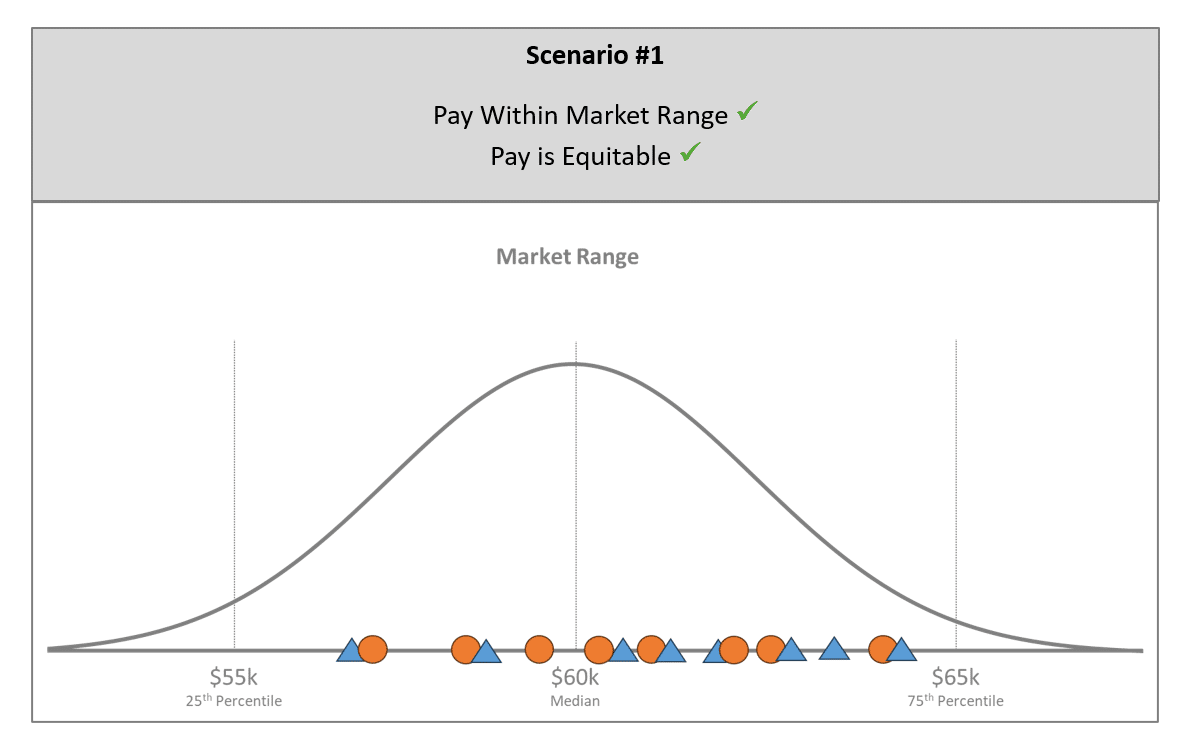
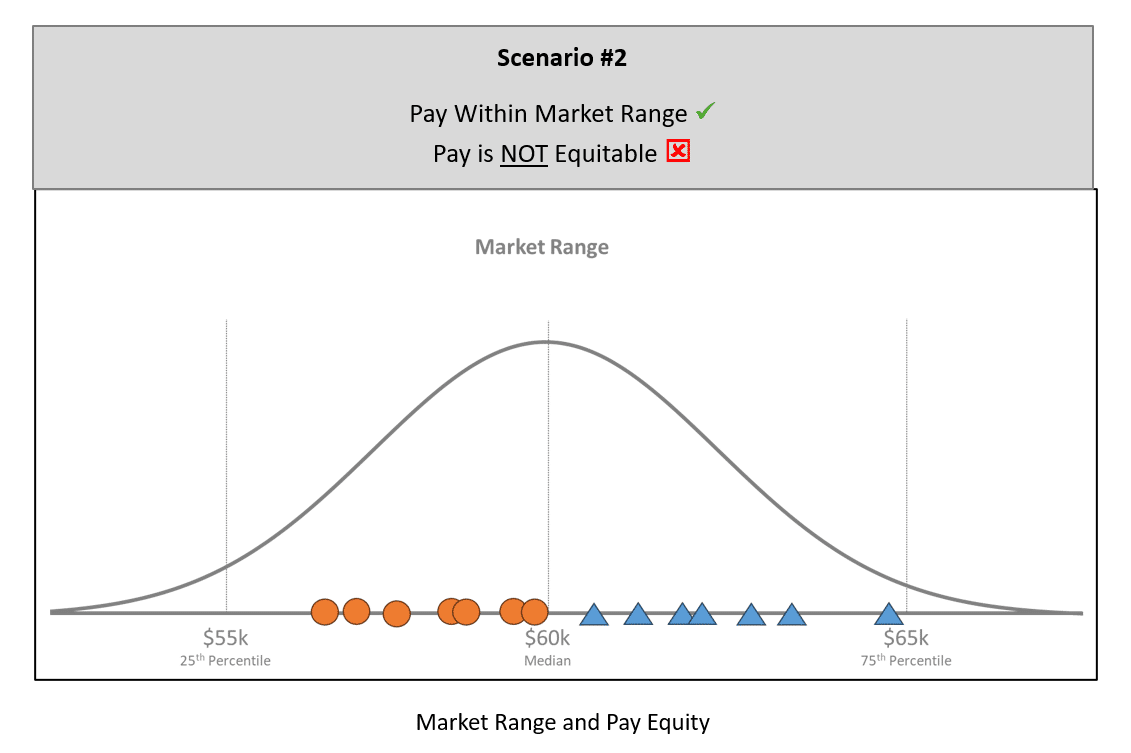
Let’s use a simple example to illustrate. Company XYZ has two demographic groups, Orange and Blue. All employees are comparable across allowable pay factors, including skills, credentials, industry experience, and performance. Compensation is maintained within a market-informed range of $55,000 to $65,000 (the 25th to 75th percentiles).
Under Scenario #1, employees from both groups are evenly distributed across the range. In this case, pay equity is maintained, and no remediation is needed.
Under Scenario #2, employees in the Blue group are disproportionately concentrated in the upper half of the range, while those in the Orange group cluster toward the lower end. Despite every employee being paid within market benchmarks, this uneven distribution signals a lack of pay equity, warranting further analysis and potentially corrective action. Market benchmarking would not have caught this. A pay equity analysis would.
More broadly, while market ranges help inform the prevailing compensation band for a given role and location, they still leave room for hiring managers to negotiate starting pay. Over time, small differences established early can compound through successive merit cycles, inadvertently creating imbalances—even when market benchmarks are fully up to date.
Market benchmarking and pay equity analysis are complementary, not interchangeable. Benchmarking anchors pay to external market conditions, while pay equity analysis ensures that this anchor holds evenly across the workforce.
Pay equity can be politicized as virtue signaling, when in reality it’s a strategic tool for maintaining fair, defensible, and merit-based pay practices. In an environment of tighter budgets and heightened scrutiny, HR leaders must balance compliance with ongoing monitoring of deviations from their compensation philosophy, all while managing a constantly evolving workforce.
At Equity Methods, we help clients cut through the noise with rigorous, data-driven analytics that support merit-based decisions and help our clients uphold the highest standards of compensation integrity.
****************************************************
[1] US respondents to WorldatWork’s 2024-2025 Salary Budget Survey indicates a decline in average raises from 3.9% in 2024 to 3.7% in 2025, while also budgeting for a 3.6% average raise in 2026.
[2] In a memorandum directed at federally funded entities in July 2025, the DOJ states that any hiring, training, or promotion decisions made on the grounds of gender or race remain unlawful.
[3] Illinois’ Equal Pay Act Salary Transparency, effective January 1, 2025.
[4] Minnesota’s Sec. 181.173 MN Statutes, enacted January 1, 2025.
[5] The 1-in-20 threshold is the convention for pay equity analyses in the academic literature and the courts. It corresponds to the 95% confidence interval around the wage gap estimate and is also referred to as the two-standard deviation rule, or the 5% significance level for statistical inference.